


The Red Clay Problem
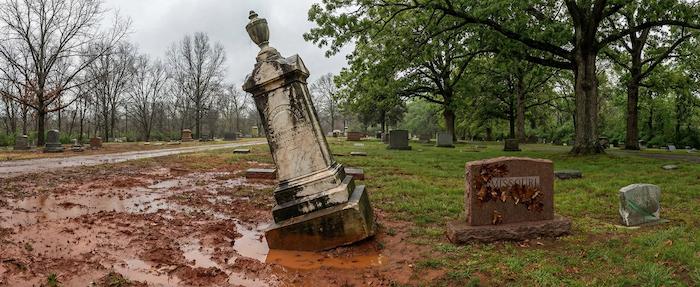
Missouri red clay is a headache. It holds water. In the winter, that wet clay freezes and pushes up hard. In the summer, it bakes dry and shrinks back from the concrete.
This push-and-pull snaps foundations. We see headstones leaning at bad angles or sinking into the mud. You can't just prop them up. For proper tombstone repair and restoration, we dig out that unstable clay. We replace it with a deep bed of compacted gravel. This drains the water away so the ground stays solid under the stone instead of shifting with the seasons.
Carthage "Marble" Decay
You see Carthage stone everywhere here. People call it "marble" because it takes a shine, but it is actually hard limestone. It is porous. It drinks up moisture and holds onto exhaust fumes.
The surface gets rough and sugary. If you rub your hand on it, white dust comes off. A pressure washer will destroy this stone. It blows the lettering right off. We treat Carthage stone gently. We use soft nylon brushes and a consolidant that soaks in and hardens the surface. We stop the crumbling so the inscription stays legible.
Humidity and Black Algae
Our summers are hot and sticky. That humidity feeds biological growth. We deal with a lot of black algae (cyanobacteria) that streaks down the face of the monuments.
It looks like soot, but it's alive. It digs into the stone pores. Scrubbing it just spreads the spores. We use a biological cleaner that kills the algae at the root. We spray it on and let it work. The black streaks turn orange, then disappear. The stone gets clean without us having to scrub the face raw.
Oak Tannin Stains
We have huge Oak and Hickory trees in our cemeteries. They make a mess. Wet leaves pile up on the markers and rot. They leak tannins onto the stone.
This leaves a dark brown smear that soaks right into the rock pores. Soap won't touch it. We use a specialized poultice for headstone cleaning services. We apply the paste to the stained area. It draws the brown oil out of the rock and into the paste. We wash it off, and the natural color returns.
Missouri Red Granite
Down in the Elephant Rocks area and beyond, we use a lot of local Missouri Red granite. It is bulletproof stuff, but the rough, natural edges catch lichen and dirt.
Lichen anchors itself in those jagged cracks. If you try to scrape it dry, you'll chip the crystals. We use a biocide to soften the growth first. Once the lichen is dead and loose, we rinse it away. It reveals that deep red color that has been hidden under gray crust for decades.
City Soot in St. Louis and KC
In the cities, we deal with a century of industrial exhaust. That carbon buildup reacts with limestone to create a black, gypsum crust. It looks like a hard scab on the stone.
You cannot chip this off. If you do, the stone comes with it. We use chemical degreasers and careful water misting. We slowly dissolve the black crust. It takes patience, but we can get down to the original stone surface without losing the carved details.
Freeze-Thaw Spalling
Missouri winters are wet. The stone gets saturated. When the temperature drops at night, that water turns to ice inside the rock. It expands and pushes the face of the stone right off.
We see this on older sandstone. The face flakes off in sheets. We can't glue the stone back, but we can stop the rot. We clean out the loose debris and brush on a sealer. This blocks liquid water from getting in, so the freeze cycle can't do any more damage.
Mower Scuffs
Grass grows fast here in the spring. Commercial mowing crews move fast, and they hit the corner markers. We see chipped granite and green rubber marks on the bases.
We can buff out the rubber marks. For the chips, we check the stability of the stone. As part of our grave site cleaning services, we also edge the grass by hand around the monument. This creates a buffer zone so the mowers don't have to get right up against the stone.