
Stone Care on the Plains
Auburn sits on red clay and sand. This soil ruins stone. In cemeteries like Pine Hill and Memorial Park, the ground attacks the markers from the bottom up.
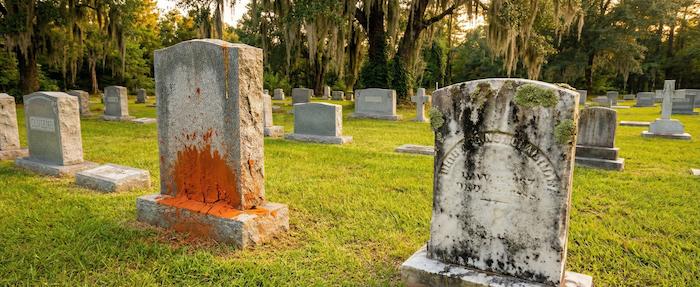
We fight the red mud that splashes up during storms and dyes the white marble orange. We also deal with sticky pine sap from the trees that line the city. Families searching for headstone cleaning services near me call us to remove these deep stains and stabilize markers that are sinking into the sandy patches of ground.
Red Clay Iron Stains
The clay here is full of iron oxide. Rain splashes this red mud onto the porous stone bases. The stone drinks the color deep into its pores.
Water won't touch this stain. The iron is locked inside the rock. We use a chemical poultice. We cover the stain with a paste that sucks the rust out. When we peel the paste off, the stone is white again.
Pine Sap Removal
Pine trees are everywhere in Auburn. They drop sap on the monuments. The sap hardens and traps dirt, creating black tar-like spots.
Scraping the sap scratches the stone. We use a solvent to soften the resin. The sap wipes off clean, leaving the polish safe. We also clear the acidic pine needles that pile up and eat into limestone markers.
Sinking in Sandy Soil
Auburn has patches of loose sand. Rain scours it out from under the stones.
We see monuments tipping over as the ground erodes. We lift the stone. We dig out the loose dirt and backfill the hole with crushed angular gravel. The gravel locks together. It creates a stable base that drains water so the stone doesn't sink again.
Lichen on Rough Granite
The humidity here fuels lichen growth. It forms hard, crusty patches on the rough edges of granite stones.
The lichen roots grow into the stone surface. Pulling it off creates pits. We use a biological cleaner. We saturate the growth. The chemical kills the plant and detaches the roots. The dead lichen washes off, leaving the stone intact.
Bronze Corrosion (Memorial Park)
Auburn Memorial Park has hundreds of flat bronze markers. The humidity and lawn fertilizers destroy the protective clear coat.
The metal oxidizes and turns a chalky green. We restore these on-site. We strip the failed lacquer. We blast the corrosion off with glass beads to get down to clean bronze. Then we apply a heavy industrial coating to seal the metal against the moisture.
Black Algae on Marble
The damp air creates black algae streaks on older white marble stones. It looks like soot, but it is a living organism.
Pressure washing destroys soft marble. We use a biocide wash. It soaks into the stone and kills the algae at the root. The black stains turn brown and rinse away with the rain.
Mower Damage
In the manicured parks, markers settle until they are flush with the grass. Mower blades hit the edges.
We see chipped granite and gouged bronze. We lift these markers. We set them on a new base so they sit level with the ground but safe from the blades. We smooth out the sharp chips on granite to prevent further cracking.
Service Costs in Auburn
Cleaning red clay and pine sap requires specific chemicals and time. Leveling stones in sandy soil is labor-intensive. We inspect the marker to see the extent of the damage before giving a quote.
- Clay Extraction: Removing deep red iron stains.
- Sap Cleaning: Dissolving sticky pine resin.
- Bronze Restoration: Refinishing corroded metal plaques.
- Leveling: Raising stones in sandy soil.