
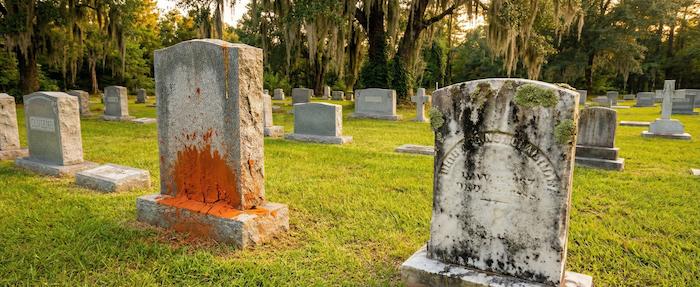
A gravestone in the red clay hills east of Birmingham can pick up an iron stain within its first rainy season; a marker under the live oaks near Mobile Bay stays clear of iron staining and answers to the coast's own humidity year-round. Tending's crews perform headstone cleaning and restoration at all 10,098 of Alabama's cemeteries, and every one of those visits falls under a $2,000,000 liability policy plus the company's ICCFA membership. How much cleaning a marker needs, and which method fixes it, depends on exactly where in Alabama it stands.
How Alabama's Climate and Soil Shape Headstone Cleaning
Central Alabama's clay hills send iron-rich mud onto pale stone every time it rains, and the same storms turn tropical and humid once they reach the Gulf coast. Some of the state's oldest cemeteries sit further inland, holding soft marble markers that have stood through more than a century of rain and heat, and each decade leaves a fresh mark on the stone's surface.
Piedmont Red Clay Staining and Bronze Marker Restoration
Alabama's Piedmont region carries some of the reddest topsoil in the South, colored by iron oxide suspended in every heavy rain. A hard shower splashes the reddish runoff across low granite and bronze markers, and iron particles settle into open stone pores within minutes. Granite's tight crystal structure leaves fewer open pores for iron to settle into, so marble across the same cemetery often picks up color first. Left to dry under Alabama sun, the residue bakes into an orange-brown ring that ordinary dish soap cannot budge. Scrubbing an already-baked stain only grinds the iron particles deeper into the pores. Bronze plaques set into granite and marble markers nearby develop a matching rust-colored crust whenever storm runoff crosses them. A chelating poultice draws the iron back out through the pores it entered, curing for several hours before it peels away with the stain attached. Bronze marker restoration applies an identical chelating approach directly to the metal, since a plain water rinse barely touches iron already bonded to bare copper alloy. Cemetery sections near unpaved access roads tend to show the deepest staining, since passing vehicles keep raising fresh red dust between storms.
Gulf Coast Humidity and Headstone Lettering Repair
Mobile Bay and the rest of coastal Alabama stay humid through most of the year, and porous granite and marble markers soak up the moisture straight from the air. Summer humidity along the coast regularly holds above eighty percent for weeks at a stretch. Black mold and green algae take hold on a wet surface within a single season, feeding on minerals in the stone as they spread, and a marker can turn fuzzy black or green before anyone notices the colony has started. Alabama winters rarely turn cold enough to kill the growth back, so it keeps expanding season after season. High-pressure washing strips a biological film off quickly. It also chips paint out of carved letters, so cemetery crews keep pressure washers away from lettering. A biocide solution soaks into the pores where mold and algae are growing and kills the root system along with the visible film. A single pass rarely reaches every colony hidden in the stone's pores, so a follow-up application several weeks later catches whatever spores survived the first treatment. Cemeteries under heavy tree cover often need a second treatment sooner, since shade keeps stone damp for days after a storm has cleared everywhere else. Rain rinses the dead organic material away over the following weeks and leaves the stone's original polish underneath. Humid coastal air also fades paint out of carved letters early, and headstone lettering repair restores it once the surrounding growth has been treated.
Black Belt Marble Sugaring and Headstone Restoration
Alabama's Black Belt holds some of the state's oldest cemeteries, many still marked with soft white marble carved before the Civil War. Acidic rainfall dissolves the calcite that holds marble grains together, one grain at a time, over decades of exposure. Conservators have a name for the result: sugaring. The surface crumbles into something close to granulated sugar once enough calcite is gone. The process usually takes decades to reach a crumbling stage, and it speeds up quickly once enough surface area opens up to catch rainfall directly. White marble's coarse crystal grain has little holding it together once the calcite binder breaks down, so sugaring shows up fastest on white stone. Wiping a crumbling surface pulls carved names and dates away with the dust, so cemetery crews treat the stone before they ever clean it. A penetrating silicate hardener soaks into weakened marble and cures into a solid mineral structure, locking the loose grains back in place. Headstone restoration stabilizes the stone first, and only then does surface cleaning move forward on a marker stable enough to survive it.