
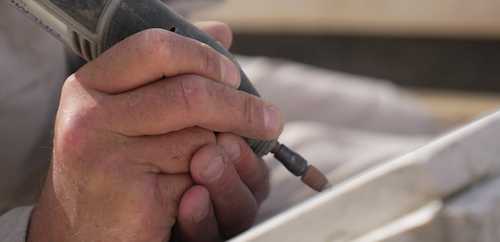
Alabama's climate doesn't damage headstone lettering the same way in every county. Gulf Coast humidity swells paint against granite grooves, limestone-valley well water bakes calcium crusts over carved names, and Wiregrass sun bleaches pigment to powder within a few seasons — the mechanism changes by region, but the result is the same blank stone. Tending provides headstone lettering repair across Alabama and works directly at the grave — no marker gets removed or shipped anywhere to do it. Every technician carries a $2,000,000 liability policy and follows guidelines set by the ICCFA, so families and cemetery staff get the same insured, consistent work whether the marker stands near Mobile Bay or in a Tennessee Valley churchyard.
The Wiregrass Region and UV-Bleached Enamel
The fastest lettering fade shows up in the Wiregrass, where longleaf pine farmland leaves rural cemeteries with almost no canopy overhead. Without shade, the carved enamel bakes in direct sun for most of the day, and that constant UV exposure dries the pigment into a chalky film years before it would fade under a wooded lot further north. The chalk sheds first, then flakes out of the grooves entirely, leaving a name that reads as a faint outline, not solid lettering.
Families around Dothan, Enterprise, and Ozark tend to notice the same way: photos from a few years back show crisp black letters, and the stone in front of them shows almost nothing. Once the pigment has chalked out this far, no amount of wiping or rinsing brings the contrast back — the enamel bond is already gone, and the groove needs a full clearance and refill. This part of the state generates more monument lettering repair visits than any other, a pattern covered in more detail in a blog post about fading and flaking headstone paint in Alabama.
Gulf Coast Humidity and Lifting Paint
A newly lettered headstone near Mobile Bay rarely stays crisp for more than a few years. The Gulf Coast carries heavy humidity almost year-round, and that moisture works into the enamel's binder and swells it against the granite groove walls until the paint no longer holds to the stone. The letters don't fade evenly — they lift out in visible flakes, sometimes losing an entire word at once while the rest of the inscription still looks intact.
The pattern shows up most often on markers within a mile or two of the bay, where salt air adds to the humidity load. Tending treats this as a full groove clearance, not a touch-up — paint left clinging to swollen granite keeps lifting around a fresh patch and leaves an uneven, blotchy result. Coastal families searching for gravestone lettering repair usually find this out only after a cheaper patch job has already failed once.
Limestone Valleys and Calcium-Packed Letters
The most common question from families in north Alabama's limestone valleys isn't about fading — it's about the white crust covering the letters. Cemeteries in this region often draw irrigation from the same limestone aquifers that carved the area's caves and sinkholes, and that mineral-heavy water flashes into steam off sun-heated granite and leaves calcium residue behind. Repeated waterings pack that residue into the carved letters until it buries whatever paint is left underneath.
Pressure washing does not solve this; it can drive mineral scale deeper into the groove and abrade the stone face around it. Tending's technicians dissolve the calcium chemically before any repainting starts, clearing each letter back to bare granite so the new enamel bonds to clean stone, not a mineral film. This chemical clearance is the most requested headstone lettering repair in the Tennessee Valley, ahead of straightforward repainting.
lettering repair Costs Across Alabama
Tending prices this work by character count and groove depth, not by plate size or the stone's overall condition — a short surname costs less to refill than a full verse, regardless of how large the headstone itself is. Pricing is fixed before any work begins: families choose the package on our online calculator, and that number holds statewide, whether the marker stands in a Mobile Bay churchyard or a rural Wiregrass cemetery. There is no on-site estimate and no separate travel charge added afterward. Some families search for engraving restoration once the carved names have chalked out completely, but the process is the same character-by-character repaint described here, not new engraving or added text.
- Single-line refill: clearing and repainting one line of shallow-carved lettering, priced per character.
- Full inscription refill: clearing and repainting an entire carved inscription, including name, dates, and epitaph lines.
- Deep-groove restoration: extra solvent and enamel passes for letters carved deeper than a standard factory cut.
- Calcium and mineral clearance: chemical removal of hard-water scale packed into the grooves before repainting.
- Font-match verification: side-by-side comparison against the original carved style before enamel goes on.
lettering repair covers paint and enamel only. Cracked or broken granite falls under headstone repair and restoration, and tarnished or corroded plaques are handled through bronze marker restoration — either can be scheduled alongside a lettering job when a marker needs both.
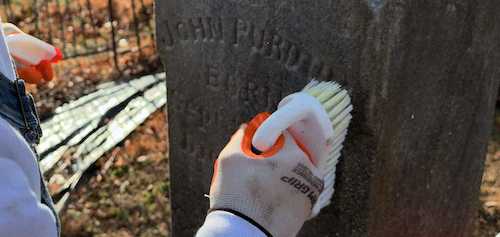
How Tending's Headstone lettering repair Process Works
- Groove Clearance A technician clears each carved groove of remaining flaked paint, chalked pigment, or calcium residue using steel picks and other non-abrasive hand tools, working letter by letter without touching the surrounding polished granite face.
- Solvent Preparation A commercial-grade solvent flushes each cleared groove to strip out leftover binder or mineral film, leaving bare stone ready to hold new pigment.
- Drying The grooves air dry completely before any pigment goes in. Sealing enamel over residual moisture is the most common cause of lettering lifting again within a year, so this stage runs on its own timeline and is never rushed.
- Enamel Application Commercial monument lithichrome is worked into each dried groove by hand, matched to the original letter depth so the cured pigment sits flush with the carved line, not raised above the stone.
- Polishing & Finishing Excess enamel is polished off the granite face and the finished lettering is checked against reference photos, then a technician uploads a close-up confirmation photo through the Tending app so the family can review the completed work remotely.
