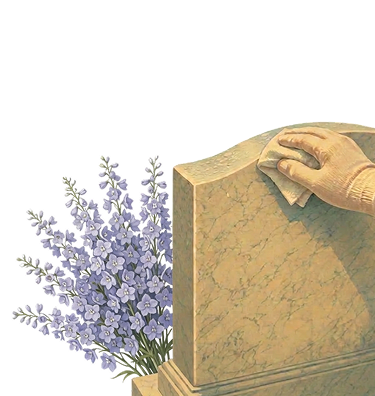
Lettering: How to Bring Faded Headstone Inscriptions Back to Life
Tending's short answer: faded headstone lettering means the factory paint filling the carved letters has broken down — the stone itself is fine. Restoring it means clearing the grooves down to bare stone and refilling them with UV-resistant monument enamel in a five-step process; hardware-store paint, wire brushes, and pressure washers are the most common ways families accidentally make it worse.
Families rarely notice it all at once. First the thin strokes inside the dates disappear. Then the middle row of an epitaph fades out.
That is the moment lettering restoration becomes necessary — the professional refilling of carved inscriptions on a memorial. Inside Tending, it is one of four core grave-care services, alongside headstone cleaning, monument repair, and bronze marker restoration. Below is how lettering restoration is done properly, what can go wrong when families try it themselves, and how we approach the work.
Headstone lettering repair vs restoration: what's the difference
Short answer: There's no strict industry line between the two. "Repair" usually means touching up a single damaged or chipped letter, while "restoration" means refilling the entire inscription panel, clearing every groove and repainting all the lettering, not just the worn parts. In practice, most professional work, including Tending's, treats the whole panel rather than isolated letters, since a partial repaint rarely matches the surrounding color and tends to look patched.


Why Inscriptions Fade
At the factory, stonecutters fill the carved letters with a specialized monument-grade enamel — a pigment in a chemical binder designed to bond with the pores of the granite and hold for decades. In practice, that binder breaks down much earlier, and the reason depends on the region.
In California, UV radiation hits the stone roughly three hundred days a year. The binder breaks down, the pigment shifts from black to a light gray chalk powder, and the first winter rain flushes the dead powder out of the grooves. On top of that, California cemeteries irrigate with reclaimed water; that water hits the base of the stone every day, evaporates in the afternoon heat, and leaves a hard calcium scale packed inside the carving.
In Florida, salt air breaks the chemical binder faster than anywhere else, layered with black mold and marine corrosion. In New York, the problem is inverted: road salt eats the factory enamel, freezing rain fills the grooves, the water turns into ice, and the ice expands until the paint pops out. In Michigan, calcium carbonate dust from zebra mussel shells settles into the lettering and bakes into a solid plug under lake-effect sun. In Virginia, we routinely deal with coal aerosols from coastal export terminals and Albemarle soapstone dust that mechanically forces the paint out of the channels.
The outcome is the same everywhere: the stone goes blind. The family's history becomes unreadable.
How Headstone Lettering Restoration Works
Proper lettering restoration is not painting. It is a controlled, multi-step process that starts with clearing the carved grooves, continues through chemical preparation of the stone, and finishes with refilling the cuts with a material engineered to bond with granite. Each stage matters — skipping any one of them is the reason most amateur attempts fail within a season.
The standard industry sequence runs through five stages.
Groove clearance
Old failed pigment, mineral deposits, organic debris, and tree sap have to come out of the carved letters before anything else can happen. This requires precision hand tools — steel picks, small gouges, and carbide cutters for tougher mineral plugs. The grooves must be cleared down to bare stone. Wire brushes, abrasive pads, and pressure washers cause damage and have no place in professional work.
Solvent preparation
The cleared channels are washed with a commercial solvent designed for monument work. This degreases the granite and dissolves any remaining residue. The stone has to be chemically clean before any new pigment touches it — otherwise the new paint will not bond and will fail in months.
Drying
The stone has to be completely dry before painting. Residual moisture inside the rock will trap solvents and weaken the bond. Professional crews use forced-air or thermal drying rather than waiting for ambient evaporation.
Enamel application
The clean, dry grooves are flooded with a commercial monument enamel — a UV-resistant pigment specifically formulated to bond with porous stone. This is the same class of material the original factory stonecutter used when the monument was first installed. Standard outdoor paint, masonry paint, and aerosol craft paints do not belong in monument restoration; they do not adhere to granite under temperature stress.
Polishing and finishing
Once the pigment flash-cures, the excess is wiped off the polished face of the stone with a pumice block — leaving the letter edges crisp and the surrounding granite untouched. Done correctly, the carved text looks the way it did the day the monument was installed.
One principle runs through all five stages and is non-negotiable in professional work: the original font and carving are never altered. Restoration refills what the stonecutter carved. It does not redesign, deepen, or "improve" the letters.
Replacing gold lettering
Genuine gold leaf (23 karat or higher) doesn't oxidize or fade the way paint does, and holds its finish for roughly 20 to 30 years when applied correctly and left unsealed, most sealers break down within a few years and end up shortening the gold's lifespan rather than protecting it. What looks like failed gold leaf is often actually a cheaper gold-colored paint or spray finish, which typically fades within a year and isn't a like-for-like replacement.
Lead lettering repair
Older headstones, particularly from the mid-1800s to around 1930, sometimes used individual lead letters set into the carved grooves rather than paint. The lead itself holds up well, but the pins or adhesive holding it in place deteriorate over time, and freeze-thaw cycles on marble can pop letters loose entirely. Because matching replacement lead letters are rarely available today, the standard professional approach is to carefully reattach and consolidate the original letters wherever possible, rather than replace them outright.


The Risks of Doing It Yourself
When relatives see a faded headstone, the instinct is to fix it themselves. We see the consequences of those attempts every week, and a few risks need to be stated plainly.
Hardware store paint will fail and will stain the stone. Standard outdoor or spray paint is not formulated for porous granite. It cannot handle the surface temperature of stone in July — it peels off in weeks. Worse, the pigment soaks into the polished face of the granite and leaves marks that cannot be removed without grinding. A bad paint job is significantly more expensive to fix than a clean restoration would have been from the start.
Wire brushes tear out what is left of the original pigment. When a family sees a white calcium crust and tries to scrub it off, the abrasive friction strips the remaining factory paint out of the grooves along with the scale. Hard water deposits cannot be scrubbed away — they have to be chemically dissolved.
Pressure washers can split the stone. High-pressure water destroys the sharp carved edges and forces moisture into microscopic fissures in the rock. At the first hard winter freeze, the stone can crack along those lines, turning a cosmetic issue into a structural one.
The wrong solvent eats the polished finish. Cemetery monuments have a specific surface finish from the factory. Off-the-shelf chemical cleaners — including common rust removers, tile cleaners, and bleach-based products — can permanently dull or etch the polished face. Once that surface is damaged, only professional re-polishing can restore it.
Monument-grade materials are not sold to the general public. The commercial enamels and solvents used in professional restoration are distributed through trade channels, not consumer hardware stores. Families with the right intentions often end up using the wrong materials simply because the right ones are not available to them.
The original details get lost. Long epitaphs, military service marks, and decorative carving need more time and precision than a family member typically has available at a cemetery visit. Amateur work tends to focus on the main name and leave the rest fading — which is the opposite of what makes a stone readable as a whole.
Can you repaint headstone lettering yourself?
Short answer: not really, not safely. Everything described above, the right enamel, the solvents, knowing when the stone is dry enough to paint, is hard to replicate without trade access and training. If a stone just needs light surface cleaning and the cemetery allows it, that part is reasonable to do yourself; repainting the actual lettering is where amateur attempts consistently go wrong, for all the reasons already covered above.


How Tending Approaches Lettering Restoration
A professional crew brings three things to the job that families cannot replicate on their own: the right materials, repeatable execution, and accountability for the result.
Materials. We use the same class of commercial monument enamel that factory stonecutters use — a UV-resistant pigment formulated to bond with granite under heat, salt air, and freeze-thaw cycles. We pair it with commercial solvents matched to that enamel, carbide gouging tools for difficult cases, and a pumice block for finishing. None of these are interchangeable with hardware-store equivalents.
Process. Every Tending crew works to the same five-step protocol — groove clearance, solvent prep, drying, enamel application, polishing — performed in the same sequence, with the same materials, under the same supervision. The result is consistent regardless of which technician visits the cemetery.
Full-panel restoration. We do not touch up only the main family name. We restore the entire carved panel: full names, every date, the complete epitaph, military designations, and decorative carved elements — character by character. Families get back the inscription the way it was installed, not a partial cosmetic fix.
On-site work, no monument movement. The entire job is performed at the cemetery plot. We do not lift the stone off its base, we do not disassemble the monument, and we do not disturb the installation. Every time a monument is moved, it risks damage to the base, the seals, and the alignment.
No font alteration. We work only inside the existing grooves the factory stonecutter carved. The original lettering style is preserved exactly — we restore, we do not redesign.
Insurance and accountability. Every crew visit is covered by a $2,000,000 liability policy. If something does not look right in the photo report, we come back and fix it. A self-restoration leaves the family carrying both the cost and the risk; professional restoration shifts that risk onto us.
Frequently asked questions
Can you repaint the lettering on a headstone?
Yes, if the letters were originally painted. The old paint is cleared out of the carved grooves down to bare stone and refilled with UV-resistant monument enamel. Hardware-store or masonry paint looks fine at first but breaks down quickly outdoors. Most cemeteries treat lettering work as something that needs their approval first.
What kind of paint is used for headstone lettering?
Professionals use UV-resistant monument enamel made for outdoor stone. Standard outdoor paint, masonry paint, and aerosol craft paints fade, peel, or stain the stone around the letters, and correcting them is harder than doing the job right the first time.
Can lettering on a headstone be changed or a new name added?
Restoring existing lettering and adding new lettering are different jobs. Tending restores inscriptions that are already on the stone. Adding a name or date means cutting new letters, which a monument company does with the cemetery's approval.
How much does headstone lettering restoration cost?
With Tending, inscription repainting is part of one-time restoration. Prices are the same in every U.S. state, and the full price table is on the pricing page.