A bronze veteran's plaque near Florida's coastline can corrode green within a few short years from salt-laden wind alone; a granite headstone on sandy inland ground can sink and tip after a single heavy tropical storm liquefies the soil underneath it, with no coastal salt anywhere nearby. Tending covers all 3,985 of Florida's cemeteries under one $2,000,000 liability policy, with ICCFA & FCCFA membership standing behind every visit. Families who live in Florida get the same in-person visits as anyone managing a memorial from out of state through the Tending app. Which fix actually helps a Florida headstone depends on what's really behind the damage.
How Florida's Humidity, Salt Air, and Sandy Ground Shape Headstone Care
Florida's humidity breeds algae that stains engraved letters within a single wet season. Coastal salt air corrodes bronze markers statewide, and sandy, saturated ground liquefies under heavy rain and swallows monument foundations whole.
Florida Humidity and Headstone Lettering Repair
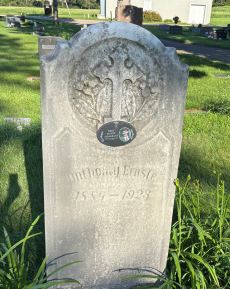
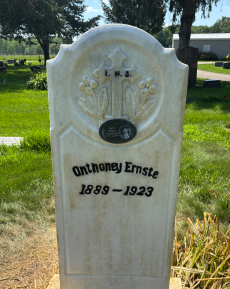
Granite cemetery markers in Florida rarely have more than a day or two to dry out between rain showers, and black algae spores that settle in during a wet stretch lodge into the stone's open pores before the surface dries again. The growth spreads as a dark film across engraved lettering, and the paint underneath stains along with it. Cemeteries under heavy tree canopy see the worst algae growth, since shade keeps the stone from ever getting the direct sun exposure that would otherwise help it dry faster after each rain. Florida's intense, near-constant sun works on the same surface a different way, breaking down the stone's sealed finish and fading a dark granite face to a dull, chalky gray over several years. A faded, chalky surface makes engraved letters even harder to read on top of whatever the algae has already done to the contrast. Markers on the west and south faces of a monument tend to fade fastest, since those sides catch the most direct sun through the middle of the day. An industrial-grade biocide kills the algae at every layer it has reached, and Tending's crew clears the dead growth away by hand to avoid scratching the surface underneath. A penetrating stone conditioner addresses the sun-faded finish separately, resaturating the surface with moisture and depth before a UV-resistant clear coat goes on to slow future fading. Headstone lettering repair follows once both problems are addressed, with fresh marine-grade enamel going into the bare grooves, built specifically to hold up in Florida's humidity.
Coastal Salt Air and Bronze Marker Restoration
Wind off the Gulf and Atlantic coasts carries fine salt particles well inland, and the particles settle onto any exposed bronze marker in the area. Salt reacts with the copper in bronze alloy and forms a chalky green compound. The compound pits the metal's surface over the following months. After a few years without treatment, the pitting reaches deep enough to cover cast lettering. Plaques mounted close to the water, whether on a coastal cemetery or along one of Florida's tidal rivers, tend to reach this point fastest, since salt concentration in the air drops off the farther a marker sits from open water. A chemical stripping process lifts the corrosion away without touching the surrounding bronze, and Tending's bronze marker restoration finishes with a marine-grade coat that goes on immediately afterward so oxidation doesn't get a chance to restart.
Florida Ground Liquefaction and Headstone Repair
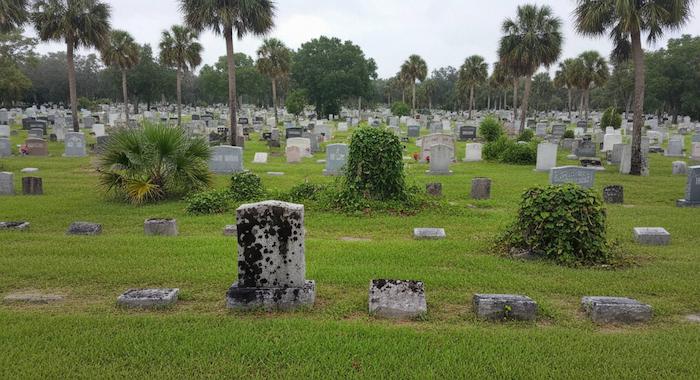
Much of Florida sits on sandy soil with very little clay in the mix. A few hours of heavy tropical rain fills the gaps between sand grains with water, and a concrete base sitting on the saturated ground can sink several inches within a single storm. The corner where the sand liquefies first sinks into the ground and pulls the rest of the monument off level with it. Florida's rainy season, running roughly from June through September, is when most liquefaction damage happens, since that's when the state sees the bulk of its heaviest, most sudden rainfall. Headstone repair in these conditions begins below the surface, with a rebuilt foundation put in place before the stone itself gets reset. Tending removes the loosened sand around the base, replaces it with compacted aggregate that resists liquefying again, and resets the monument level on that new foundation.