
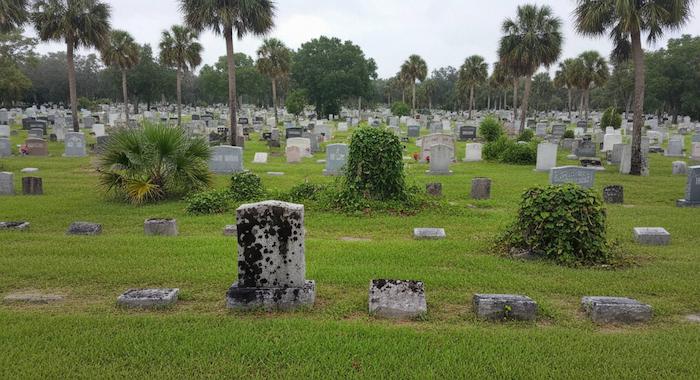
Pensacola Gulf Salt Spalling on Headstones
Pensacola sits between the bay and the open Gulf, and the air here carries a steady mist of salt no matter which way the wind blows. That brine lands on granite markers constantly, and porous stone pulls it in the same way it would rainwater, holding the salt deep inside long after the surface looks dry. When the sun finally evaporates the moisture, the dissolved salt has nowhere to go — it crystallizes right there inside the stone's pores. Those crystals take up more space than the salt did in solution, and the pressure builds until a piece of the stone's outer face pops loose entirely, a process restorers call spalling. A lot of the advice that comes up when people search for headstone cleaning services near me points straight at a pressure washer, and that's the worst possible fix for a marker already spalling — the force drives moisture and salt even deeper into the stone, feeding the exact crystallization that caused the damage. Tending's crew draws the salt out with a desalination poultice built to pull dissolved minerals from deep inside the stone before they get the chance to crystallize again. Spalling often takes chips of carved lettering with it when a face pops loose, and no amount of cleaning brings that detail back on its own. When that's already happened, the same appointment covers headstone lettering restoration too, filling in or recutting whatever sections were lost so the inscription reads whole again. Every crew Tending sends out along the Gulf Coast operates under a $2,000,000 liability policy, and our recognition from the ICCFA gives Pensacola families an added layer of industry-backed trust.
"Excellent fast reliable work. They did a fantastic job and I'm very pleased with them."
— Phillip Pessar, Miami, Florida

Escambia White Sand Grave Marker Sinking
Escambia County's native soil is almost pure white quartz sand, fine enough that it behaves closer to liquid than solid ground once it's saturated. A tropical system can dump enough rain fast enough that the sand loses nearly all its ability to hold weight, and water rushing underneath a monument's footing carries that sand away as it drains. What's left behind is a footing resting on essentially nothing, and the stone above tilts or drops as soon as its own weight catches up with the missing support underneath. Shoveling more sand on top does nothing for the emptiness underneath — it just gives the next downpour something new to carry off. Tending's crew digs past the compromised sand entirely and packs the footing with angular gravel, a material that locks together and holds its shape under load, unlike the sand it replaces. A monument that has already cracked from that kind of movement gets the fix on the spot — headstone repair and restoration joins the same appointment, and the base gets rebuilt properly before the crew leaves.
North Escambia Red Clay Headstones
The sandy soil that covers most of Escambia County gives way to red clay farther north, and that clay carries enough iron to leave a mark wherever it lands. Heavy rain splashes the mud onto the lower half of a headstone, and the sun bakes it into the stone's pores before anyone has a chance to rinse it off. Left long enough, that residue turns into a stubborn reddish-brown stain that plain soap and water never touch, because the iron and the stone's minerals have already bonded chemically by the time anyone notices it. Our crew works the stain loose with a chelating treatment formulated to break that iron bond specifically, lifting the discoloration out of the pores layer by layer until a final rinse brings the original color back.
St. John's Oak Lichen on Monuments
Pensacola's oldest cemeteries, places like St. John's, still stand under live oaks planted well over a century ago, with a canopy thick enough in spots to block direct sun entirely. That deep, permanent shade keeps stone damp for days after any rain, and it's exactly the environment lichen needs to spread across a monument's surface. Lichen isn't algae, and it doesn't behave like the black film that grows in sunnier coastal cemeteries — it's a fungus, and its root-like structures reach into the stone's mineral grain itself. Scrubbing a lichen patch tears loose pieces of that grain along with it, so Tending's crew never scrapes one off by hand. Instead we apply a biological inhibitor that breaks the organism down chemically until the patch dries brittle and lifts free on the next rinse, with the stone face underneath left untouched. The same deep shade that grows lichen also keeps bronze plaques and markers damp longer than anywhere sunnier in the city, and that extra moisture works past a plaque's factory coating faster than it should. Once the coating fails, the copper underneath stops looking like copper at all, corroding into blotchy green patches known as bronze disease. Tending's bronze marker restoration service clears that corrosion and sets a fresh protective coating in its place, one built to outlast the shade that caused the problem.

Service Costs in Pensacola
Every plan is priced through our online pricing calculator. The marker type and the care level set a fixed cost before anyone visits the cemetery. There is no walkthrough required just to get that number. Our team confirms the scope once they are on site and only adjusts if something was not visible from photos.
- Salt spalling repair and lettering restoration: desalination poultice treatment for stone, with recut or refilled inscriptions where chips have occurred.
- Sand-related sinking repair: footing excavation and locked gravel rebuild for tilted or settled monuments.
- Red clay stain removal: chelating treatment that lifts iron-bonded staining without damaging the surface.
- Lichen removal and bronze care: biological inhibitor treatment for stone plus corrosion stripping and resealing for bronze plaques.