
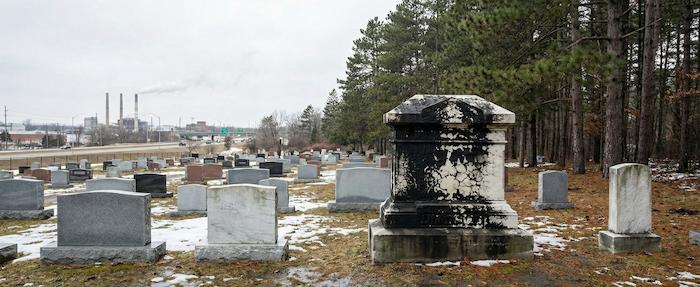
A headstone in Michigan's snowbelt near Muskegon can sit under four or five feet of lake-effect snow most winters, saturating the ground the moment it all melts at once; a bronze veteran's plaque in industrial southeast Michigan sees a fraction of that snowfall and corrodes instead from a century of factory air. Tending cleans headstones the same way at every one of Michigan's 3,992 cemeteries, with a $2,000,000 liability policy and ICCFA membership standing behind each visit. Which fix actually helps a Michigan headstone depends on what's really behind the damage.
How Michigan's Lake-Effect Snow and Industry Shape Headstone Care
West Michigan's lake-effect snowbelt buries cemeteries under some of the heaviest snowfall east of the Rockies, and that much snow does damage two different ways once it finally melts. Southeast Michigan's century of automotive manufacturing leaves its own mark on bronze markers, a problem the snowbelt further north rarely sees.
West Michigan Snowbelt and Headstone Repair
A narrow band of West Michigan roughly ten to fifteen miles inland from Lake Michigan's shore, centered around Muskegon and Oceana County, averages more than 100 inches of snow most winters, among the heaviest snowfall totals anywhere east of the Rocky Mountains. That much snow insulates the ground underneath it for months, and cemeteries across the snowbelt stay buried well past the point most of the state has already thawed. When the melt finally comes all at once in spring, the sheer volume of water saturates the ground faster than it can drain, and a heavy granite monument sitting on saturated soil starts to sink or lean within days. The same saturated ground refreezes hard the next time a cold snap hits before winter fully lets go, and whatever settling already happened gets locked in place until the whole cycle repeats the following year. The Keweenaw Peninsula in Michigan's Upper Peninsula sees the most extreme version of this cycle anywhere in the state, with some winters bringing well over 200 inches of lake-effect snow. Headstone repair in the snowbelt means digging well past the unstable, saturated layer and packing the excavation with coarse gravel that drains meltwater away fast enough to keep the ground from saturating the same way again.
West Michigan Snow Cover and Headstone Lettering Repair
Flat markers across Michigan's snowbelt stay buried under snow for months at a stretch, since the same lake-effect bands that dump over 100 inches a year keep resupplying fresh snow well into what other regions already call spring. Painted lettering trapped under that much snow sits damp for the entire winter, since meltwater constantly seeps down through the pack and refreezes against the stone overnight. Enamel paint blisters and lifts under sustained moisture like this, and by the time the snow finally clears in April, a name that was crisp in November can already be flaking away in patches. A single bad snowbelt winter can leave painted lettering visibly damaged by spring, simply because the paint never gets a real chance to dry out between storms. Cemetery sections that stay shaded longest into spring hold onto their snowpack the longest, giving paint there the most sustained moisture exposure of the year. Headstone lettering repair clears out whatever paint the winter dampness has already loosened and repaints the groove with an enamel made to cure hard even in Michigan's short, damp spring window.
Detroit Industrial Fallout and Bronze Marker Restoration
Detroit, Flint, and the rest of southeast Michigan's auto manufacturing corridor have run assembly plants, paint shops, and foundries for well over a century, and airborne emissions from all three have settled over the region's older cemeteries the entire time. Paint-shop solvents and foundry particulate settle onto bronze as an oily, greasy film that bonds into the metal's surface texture over time. The film traps grit and grime from ordinary city air on top of itself, and a plaque near an older industrial corridor can carry more than a century of buildup in cemeteries that opened alongside the first assembly plants. Once the buildup is thick enough, it hides the raised lettering and background color, leaving a veteran's name unreadable under a uniform dark crust. Rouge River-adjacent cemeteries near the historic Ford River Rouge complex carry some of the heaviest buildup in the state, sitting downwind of manufacturing operations running since 1917. An industrial-strength degreaser cuts through the oily film chemically, and the crew regrinds the raised lettering back to bright bronze before repainting the recessed background. Bronze marker restoration finishes with a fresh clear coat that keeps the next century of factory air from bonding as deeply.