
Michigan's own historic cemetery preservation guide catalogs how nineteenth-century marble markers, common statewide before granite took over after the Civil War, slowly erode into a soft, sugar-like texture that undermines whatever paint sits on top of them. Freeze-thaw cycling driven by the state's wide frost-depth range works at carved letters everywhere, white cedar common near Michigan's wetlands drops needles that stain paint as they decompose, and Great Lakes humidity and sun fade finishes along the coast. Tending's lettering crews carry ICCFA membership and $2,000,000 in liability coverage on every job in the state.
Marble Sugaring on Historic Michigan Markers
Michigan's state historic preservation office documents marble as the dominant monument material from the 1830s through the 1850s, well before granite became standard after the Civil War, and cemeteries like Cherry Hill in Canton and Lake View in Quincy still hold many of these older markers today. Marble breaks down through a process preservation professionals call sugaring, where the stone's surface calcite crystals loosen and the once-smooth face turns granular, almost like coarse sugar. Paint sitting on a letter carved into marble depends on that surface staying intact, and once it starts sugaring, the paint loses its grip and lifts away even though nothing looks obviously wrong with the coat itself.
Freeze-Thaw Expansion Across Michigan's Frost Range
Michigan's frost depth swings from 36 inches near the Ohio border to 66 inches in the western Upper Peninsula, and every location in between logs some number of freeze-thaw cycles each winter, more of them the farther north a cemetery sits. Water trapped inside a carved letter expands by roughly 9 percent the instant it freezes, and each cycle works at any weak spot already present in the paint. A channel that has already lost a little adhesion to age takes the brunt of it, since the ice only needs to widen a spot that's already compromised. Upper Peninsula monuments can rack up dozens of these cycles in a single winter, a workout the state's southern border rarely puts a letter through even once.
White Cedar Debris and Tannin Staining
Northern white cedar grows throughout Michigan's wetlands and is commonly planted as an ornamental windbreak near older cemeteries, and its scale-like foliage sheds constantly onto the ground below. Foliage that collects inside a carved letter and starts to decompose releases tannins, the same compounds responsible for the well-documented brown staining tannins cause on painted surfaces generally, a familiar problem in the paint industry that shows up wherever organic matter sits against a finish long enough to break down. That tannin exposure doesn't fade the paint at all; it leaves a dark, uneven discoloration behind instead, most visible on lighter-colored enamel. Clearing decomposing debris out of a groove promptly is the simplest way to keep tannin staining from setting in, and cemeteries with cedar windbreaks along the property edge tend to need that upkeep most often.
Great Lakes Coastal Humidity and Sun
Lakeshore cemeteries along the west coast and the shores of Huron and Superior sit inside some of the dampest air anywhere in the state, and paint doesn't need sugaring stone, expanding ice, or cedar tannins to break down under that kind of sustained moisture, it happens on plain exposure alone. Open shoreline also strips away the tree cover an inland cemetery usually has, so sunlight lands directly on the stone's face for hours at a stretch across a full season. A letter fading this way stays intact structurally; the color is simply what gives out first.
Headstone Lettering Repair Costs in Michigan
Two numbers pulled from a family's photos, how many characters and how deep they're carved, are all the calculator needs to set a fixed price without anyone visiting the cemetery. Marble sugaring, freeze damage, cedar stains, or sun fade, the cause doesn't move that price up or down. When the repaint is done, finished photos of the lettering land in the Tending app for the family to look over on their own schedule.
How Our Headstone Lettering Repair Process Works
- Sorting the Likely Cause From Photos Sugaring marble, ice-lifted paint, tannin stains, and sun fade each look distinct enough in photos to point a technician toward a cause before the visit.
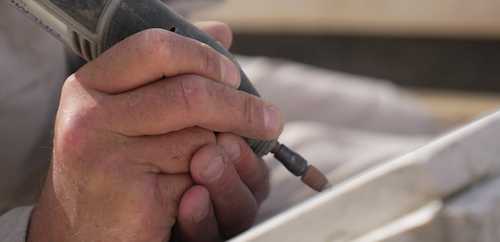
- Removing What's Left of the Old Paint A hand tool clears failed paint out of the channel letter by letter, along with any loose stone grains or plant debris, leaving intact paint in place.
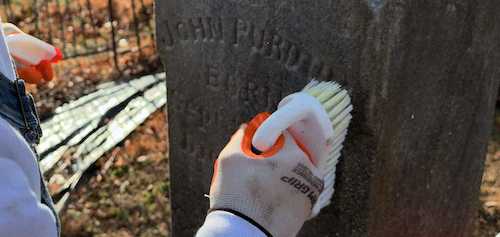
- Rinsing the Groove to Solid Ground A rinse suited to the cause, loosened marble, tannin residue, or plain grit, flushes the channel down to material sound enough to hold new paint.
- Making Sure Nothing's Trapped Underneath Air tools push every bit of dampness out of the groove first, since new paint sealed over a channel that's still even slightly wet almost never lasts a full season.
- Packing the Letters and Wrapping Up Thin coats of enamel go into the dry channel one after another until the letter sits at its original depth, then a finished photo goes into Tending's app before the crew heads out.
