Headstone Restoration Explained: Methods, Stages, and Before and After Examples
Professional headstone restoration follows four stages: a technical assessment of the monument's geometry, foundation, and material condition; foundation repair if the base is compromised; gentle stone cleaning to remove biological growth without abrasive damage; and a final protective conservation treatment to slow future soiling and moisture damage. The goal at every stage is to halt deterioration, not to make the stone look artificially new.
A headstone is not just an object crafted from granite or metal. It is a tangible vessel of memory, respect, and family history—often intimate and personal. Over time, even the most durable materials deteriorate. Weather, moisture, temperature swings, biological growth, and mistakes from past care all take their toll.
Why is headstone restoration necessary?
The reasons are more varied than most people expect.
First, materials age naturally. Stone — granite, marble, or limestone — is subject to weathering, erosion from rain and snow, and exposure to carbon dioxide and atmospheric pollution. Even the hardest stone gradually loses its original density and appearance.
Headstone slabs also often loosen and crack due to uneven aging or the material’s natural structure. Stone is a natural material with possible voids, veining, and internal stresses. Over time, inscriptions, decorative reliefs, and photos fade or wear away under the influence of weather and time.
Another recurring issue is ground settlement, foundation failure, or other factors that affect the monument’s geometry and stability — especially common with large, heavy structures.
How professional restoration proceeds
Professional restoration of a gravestone is complex work requiring technical standards and utmost care. At Tending, every project begins with a technical assessment. At this stage we do not pick up tools — we analyze. We evaluate the monument’s geometry, stability, foundation and soil condition, material type, and the nature of soiling and damage.
Very often, it is at this stage that a headstone that looks «fine» is already compromised. Even a tilt of a few degrees can create internal stresses in the stone. In «before» photos these defects may seem minor — sometimes visible only as thin hairline cracks. Without intervention, they almost always lead to more serious damage.
Even the most beautiful stone loses its dignity if the base is compromised. That is why the foundation is always checked for cracks, delamination, and signs of moisture. If needed, the base is cleaned and treated to remove biological growth using professional tools, specialty brushes, and agents designed for concrete.
If diagnostics show a compromised base or a collapse risk, full disassembly of the monument is considered. This is one of the most responsible stages. The process is never brute force: each element is removed using lifting equipment, labeled, and stored properly. Such cases are uncommon and generally tied to deep restoration needs. In practice, we often have to correct the aftermath of crude crowbar-straightening attempts where a monument looks straight but has sustained serious hidden damage.

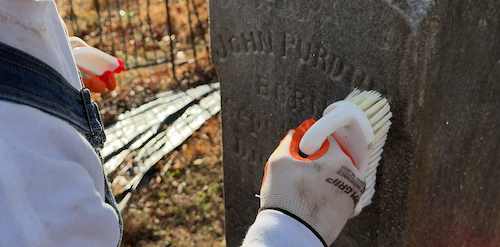
The next key stage is stone cleaning—perhaps the most underestimated part of restoration. Mistakes here are irreversible. At Tending, we routinely see the consequences of acids, household chemicals, and pressure washers that literally «burn» the stone's surface. Professional cleaning is gentle and preserves the material’s structure. Moss, lichen, biological growth, and years of built-up grime are removed. The goal is not to make the stone look artificially new but to return its natural color and depth.
If cracks, chips, or delamination are found, they are restored. The aim is not merely to mask defects but to halt deterioration and stabilize the material.
Inscriptions and decorative elements deserve special attention. Faded or lost lettering is one of the most common reasons for inquiries. In quality restoration, text becomes easy to read again without appearing out of place. The original font, carving depth, and overall style are preserved. The same applies to crosses, reliefs, metal parts, and vases. Metals like brass and bronze used for plaques oxidize outdoors; cleaning and reviving their original color is a multi-stage process. The goal is to restore readability and visual character without creating a «brand-new» look.
The final stage is conservation. After all restorative work, the monument is protected with breathable protective treatments that significantly slow moisture ingress and soiling. This is not a «magic shield forever», but a smart extension of service life that preserves the result achieved. In certain cases, waterproofing agents and consolidating treatments are applied to prevent further deterioration.


Conclusion
When we compare a monument «before» and «after» professional restoration, the difference is not only visual. The sense of neglect and hazard disappears; dignity and calm return. Most importantly, the monument stays true to itself — it is not turned into a new copy of an old object.
Professional headstone restoration is always an act of respect: for the material, for history, and for the person’s memory.