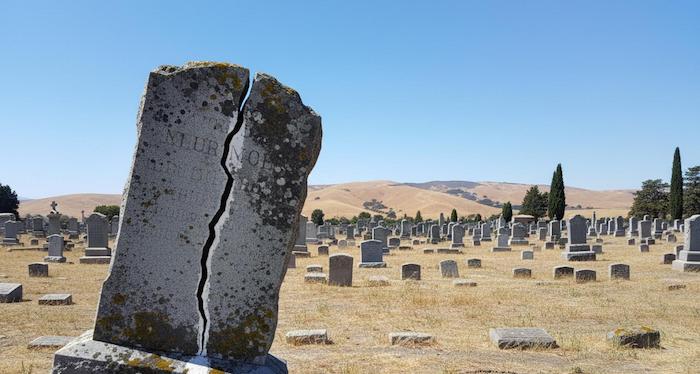
A headstone that holds up for fifty years in California's Central Valley can fail within a decade near the coast, and the reverse happens just as often. Every one of California's 2,247 cemeteries gets the same Tending headstone cleaning standard, backed by a $2,000,000 liability policy and ICCFA membership, whether the visit happens in person or gets managed remotely through the Tending app by an out-of-state family. The materials and methods change by region. The standard for the work stays the same everywhere.
How California's Climate and Geology Shape Headstone Care
Salt air attacks granite and bronze along the coast, and heat cycles combined with wildfire ash work on inland stone through their own chemistry. Ground movement, from sudden earthquakes to slow-sinking farmland, reaches monuments almost everywhere in the state eventually.
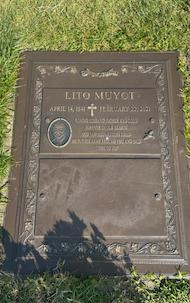
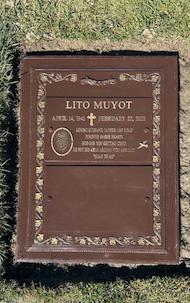
Pacific Coast Salt Damage and Bronze Marker Restoration
Ocean fog drifts inland most mornings along the coast, and it carries dissolved salt with it. The salt works into granite pores, crystallizes, and slowly pits the surface. Markers within the first mile or two of the shoreline take the heaviest exposure, since fog carrying the most concentrated salt rarely travels much farther inland before it burns off. Bronze markers face their own version of the damage. Around San Francisco and Monterey Bay, the clear coat on a bronze plaque can fail in two or three years, and green copper oxidation follows soon after across the casting. Plaques mounted flat and facing the water take the steadiest exposure, since fog rolling straight off the bay reaches them with nothing to block it. Tending's bronze marker restoration strips the corrosion down to bare metal and reseals it with a marine-grade finish. Moss and algae anchor directly into the stone's surface, so brushing them off tends to pull the polish away along with the growth. Cemeteries under mature tree cover along the coast stay damp longest between storms, since shade keeps the morning fog from ever fully burning off. An industrial biocide dissolves the growth in place instead. Standing moisture on affected monuments often fades painted lettering over time. Headstone lettering repair clears the old pigment from the grooves and packs fresh enamel in once the granite has dried.
Central Valley Heat Damage and Headstone Repair
Inland cemeteries answer mainly to heat and airborne chemistry. Central Valley granite can swing forty degrees between noon and midnight, and that daily expansion works the adhesive seal loose at a monument's base. The joint usually cracks first, well before any damage shows on the stone face itself. Monuments set on open, unshaded ground take the widest daily swing, since nothing nearby holds the afternoon heat back or slows the overnight cooldown. Wildfire season brings a separate chemical threat during the same months. Ash settles across flat surfaces overnight, and morning dew turns it into a mild caustic film that bites into polished granite by sunrise. Standard washing spreads the film around without actually lifting it off the stone. Tending neutralizes the residue chemically, then turns to headstone repair and restoration to reseal the base joint if the heat has already cracked it.
California Seismic Shifts and Headstone Restoration
Ground movement drives most of the structural damage in California, and full earthquakes are the smaller part of that. A strong jolt along the Hayward or San Andreas fault can knock a monument out of alignment within seconds. Both faults run directly through populated parts of the Bay Area and Southern California, putting a large share of the state's older cemeteries within reach of a significant quake at some point in a monument's lifetime. Slower tremors do more damage over the years, loosening the soil under a base gradually enough that nobody notices until the stone is visibly off level. The San Joaquin Valley has its own version of this problem: decades of groundwater pumping have compacted the clay under entire cemetery sections, and some plots have dropped more than a foot. Land subsidence in parts of the valley has been measured at close to a foot per year during the driest stretches, when farmers pump the hardest to make up for the water they aren't getting from surface irrigation. A sunken or tilted monument needs a rebuilt foundation, since a simple reset won't hold once the ground underneath has already given way. Tending digs out the compacted soil under the base and replaces it with graded gravel before releveling the stone on top.