
Stone Care in the Tennessee Valley
Huntsville sits in a bowl surrounded by mountains. This valley traps humidity and heat. In cemeteries like Maple Hill and Glenwood, that damp air keeps the stones wet long after the rain stops.
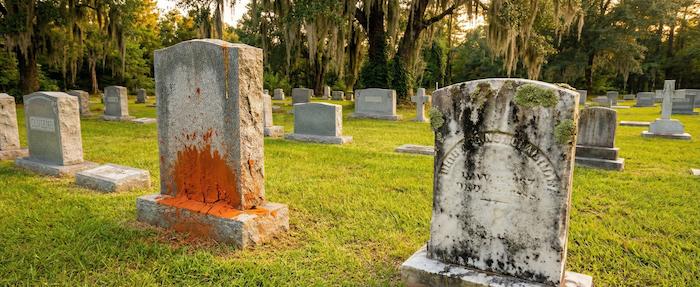
We deal with massive biological growth—lichen, moss, and black algae—that covers the limestone and marble. We also fight the red clay soil that splashes up and dyes the stone bases orange. Families searching for headstone cleaning services near me call us to kill this growth and stabilize monuments that are sinking into Huntsville’s shifting limestone ground.
Red Clay Staining
The soil in Huntsville is heavy red clay. When it rains, this mud splashes onto the porous stone. It soaks in deep.
It turns white marble a rusty orange. Standard washing won't touch it because the iron oxide is inside the rock, not on top. We use a chemical poultice. We apply a thick paste that draws the iron out of the pores. It lifts the stain without us having to scrub the soft stone surface.
Valley Humidity and Black Algae
The Tennessee Valley is humid. Moisture clings to the headstones. This breeds black algae and thick green moss.
The algae forms black streaks that hide the inscription. Moss grows in the cracks, expanding them as it thickens. We don't pressure wash this; high pressure destroys old limestone. We use a soft-wash biocide. It kills the spores and roots. The dead growth washes off with the next rain.
Sinkholes and Settling Ground
Huntsville sits on unstable limestone. The ground here is full of hidden voids. Small sinkholes open up under the topsoil without warning.
We see monuments that were level last year suddenly tip sideways. We lift the monument and inspect the ground. If we find a hole, we fill it with large angular rock. We build a new, wider foundation to bridge the soft spots so the stone stays level.
Consolidating Soft Limestone
Maple Hill has thousands of old limestone markers. They are soft. Decades of acid rain and weathering have made them brittle.
The surface turns to powder. If you touch it, white dust comes off on your hand. We can't clean these stones aggressively. We apply a stone consolidant. This liquid soaks into the crumbling stone and hardens it from the inside. It stops the dusting and saves the carving.
Bronze Corrosion (Memory Gardens)
In memorial parks like Valhalla, flat bronze markers are the standard. Sitting in wet grass and fertilizer causes the bronze to rot.
The clear coat peels off, and the metal turns chalky green. We strip the failed coating. We use glass bead blasting to clean the metal down to fresh bronze. Then we apply a high-grade clear coat to seal it against the moisture.
Lichen "Digging"
Hard crusty lichen loves the granite stones in this area. It digs roots into the crystal structure of the stone.
Scraping these spots pulls chunks of stone out. We use a chemical treatment to release the lichen. We apply the cleaner and let it work. It loosens the roots so the growth washes off without scrubbing.
Mower Damage
Flat markers in the newer cemeteries settle over time. They drop just low enough to catch dirt, or stay just high enough to get hit by mower blades.
We see gouges in the bronze and chipped granite edges. We lift these markers. We pack the hole with crushed stone and set the marker exactly flush with the ground. This keeps it clean and safe from the lawn crew.
Service Costs in Huntsville
Removing deep clay stains takes time and materials. Consolidating crumbling limestone is a specialized restoration process. We inspect every stone to determine the damage level before providing a quote.
- Clay Extraction: Removing deep red iron stains.
- Biocide Treatment: Killing heavy moss and algae.
- Limestone Consolidation: Hardening soft, powdery stones.
- Leveling: Fixing stones affected by ground settling.