The Cajon Pass Sandblaster
Rancho Cucamonga takes the first hit. The Santa Ana winds accelerate down the Cajon Pass and load the air with sharp mountain gravel. At 70 mph, that grit slams into upright monuments. It acts like industrial sandpaper.
This strips the mirror polish right off the granite face. The stone goes matte. If you are searching for headstone cleaning services near me because a memorial looks dull or gray, that is wind erosion. You can't wash it back. The surface is physically gone. We apply stone enhancers to fill the microscopic pits and seal the surface against the next storm.
This is mechanical erosion. The wind drives sharp silica sand into the stone. It grinds away the factory polish. Once that sealed layer is destroyed, the granite becomes porous. It sucks in water, dirt, and smog. The deep black contrast of the lettering turns into a flat, dusty gray.
Our protocol is protection. We clean the stone deep in the pores. Then, we apply a penetrating stone enhancer. This product fills the microscopic craters left by the wind. It restores the wet-look color. Finally, we apply a sacrificial coating. The wind attacks this coating instead of the stone. This keeps the history legible.
Wildfire Ash Corrosion
Living in the foothills means fire season. Ash falls on the cemeteries constantly. When morning dew hits that ash, it turns into a caustic paste (lye). It chemically burns the face of marble and limestone.
You can't just hose it off; it etches the stone. We use grave site cleaning services with neutralizing agents to stop this chemical reaction. We wash away the toxic residue before it eats into the inscription.
Wood ash contains potassium hydroxide (potash). When mixed with water (dew or sprinklers), it becomes lye. This is a caustic agent. It burns through the protective lithichrome paint in the lettering. On marble, it creates rough, pitted spots that look like small craters. Rubbing wet ash with a rag just smears this caustic sludge across the face of the monument.
We treat ash like a hazmat spill. We use pH-balancing rinses to neutralize the chemical reaction immediately. We flush the surface with low-pressure water to lift the particulates without scratching. We never scrub wet ash. We float it off the stone to prevent chemical etching and physical abrasion.
Seismic Shifting
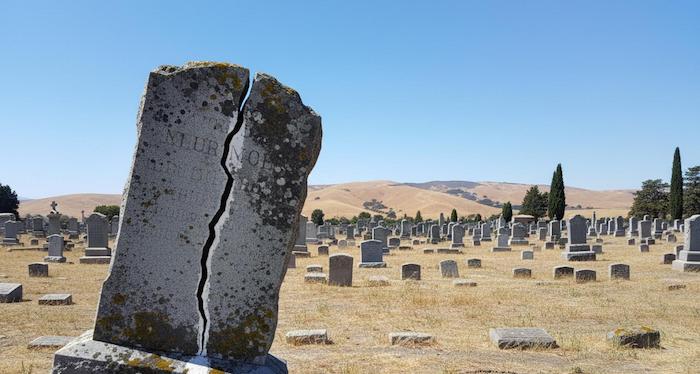
The Cucamonga Fault runs right through town. The ground is active. Constant micro-tremors vibrate heavy monuments. This shakes the adhesive seals loose. We call it "walking." The stone shifts on its base.
Our tombstone repair and restoration teams monitor for these loose joints. We re-set the monument with flexible industrial epoxy that absorbs the vibration without snapping.
Rigid mortar cannot survive here. The constant low-frequency vibration creates shear stress. It snaps the hard bond between the tablet and the base. Once that bond breaks, the monument creates a "walking" effect. It shifts inches off center. Eventually, it tips over.
We fix this by upgrading the materials. We scrape off the old, brittle cement. We replace it with an industrial, high-flexibility epoxy. This adhesive acts like a shock absorber. It allows the stone to ride out the tremors without breaking the seal. This keeps the monument upright and secure, even when the ground is active.