The Saturation Zone
Skylawn Memorial Park sits in the clouds. The marine layer hits the ridge and soaks everything. The granite never really dries out. It stays saturated.
This constant wetness breeds thick moss and orange lichen. It isn't just on the surface. The roots bore into the stone. They eat into the microscopic pores to hold on against the ridge wind.
You can't scrape this off. The roots stay inside the rock. The moss grows back in two weeks. Tending uses specialized grave site cleaning services with heavy biological inhibitors. We use a biocide that soaks deep into the stone. We kill the root system entirely. We sterilize the stone so it stays clean.
Riding the Fault
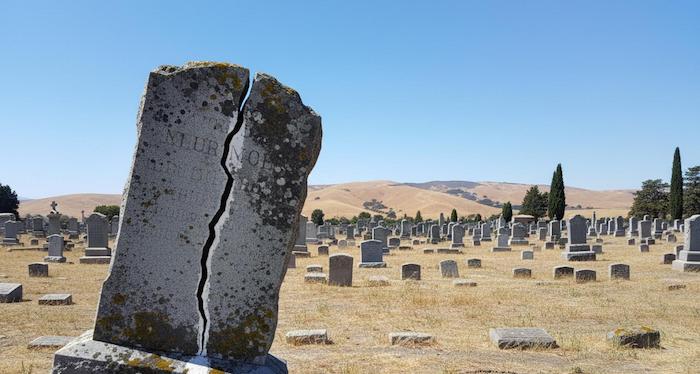
The San Andreas Fault cuts right through here. The ground is active. It doesn't need a quake to do damage. It "creeps." The earth moves constantly, dragging foundations with it.
Rigid concrete breaks. It cracks, tilts, and twists. We see monuments rotated off-center because the ground physically shifted beneath them.
If you are searching for tombstone repair and restoration because a marker is crooked, pouring more concrete won't work. The fault will break it again. We "float" the monument. We use angular, locking gravel. This allows the earth to shift without transferring the torque to the stone. It keeps the memorial upright even when the fault line moves.
Eucalyptus Tannin Burn
Eucalyptus trees are everywhere here. They are oily. When wet leaves stick to a white marble headstone, they bleed. They release a dark, yellow-brown oil.
This chemical burns a stain right into the stone. It looks like a rust spot, but it is organic dye. Soap won't touch it. The oil is deep in the pores.
If you are searching for headstone cleaning services near me to remove these spots, we use a chemical poultice. We apply a clay paste saturated with solvents. We leave it for 48 hours. The clay dries and acts like a vacuum. It sucks the oil out of the stone pores. We pull the stain out physically without bleaching the finish.
Salt Air Pitting
The wind carries ocean salt up the ridge. It settles on the stones. The water dries, but the salt stays. It crystallizes inside the granite.
These crystals expand. They blast small flakes of stone off the surface. The polish disappears. The stone feels rough. We treat this by flushing the salt out and applying a consolidant to harden the face of the stone against the wind.