


The Midwest Freeze-Thaw Cycle
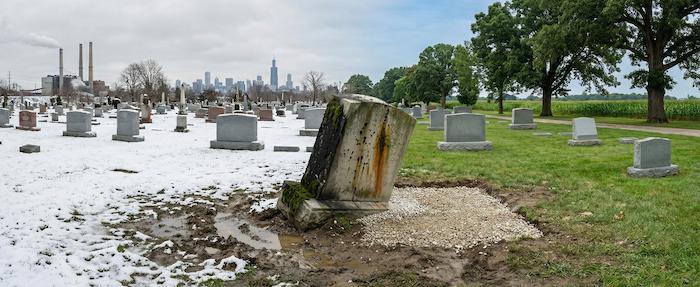
The ground here never stays put in winter. We get that heavy slush that expands when the temperature drops, then turns into a soup as soon as the sun comes out. It heaves up and sinks down all season long.
That constant churning wrecks foundations. We see headstones that have sunk or tipped over because the mud underneath just gave way. We provide professional grave site cleaning services that include leveling. We dig out the mud and pack the hole with clean crushed stone. Gravel drains. If the water has somewhere to go, the ice won't push the marker up.
Industrial Soot (The "Chicago Crust")
Up near Chicago, Joliet, and Peoria, the monuments are caked in a century of industrial filth. We’re talking about coal smoke, factory exhaust, and highway fumes that have bonded to the limestone.
That carbon buildup forms a shell harder than the stone itself. It feels like rough concrete. You can't scrub it off without destroying the carving underneath. We apply a poultice that does the heavy lifting. It sits on the grime and breaks down that hard shell. It takes patience, but eventually, the black crust softens up and rinses off without a fight.
"Corn Sweat" and Mold
Summers here are suffocating. Between the lake humidity and the "corn sweat" downstate, everything stays damp. That moisture clings to the cool north side of headstones and feeds black algae.
It looks like a dark shadow covering the names. If you scrub it with soap, you’re just spreading the spores around. We spray it with a cleaner that stops the growth dead. You’ll see it turn orange as it dies. After that, the rain washes it off naturally, and the granite looks clean again.
Hard Water Haze in the Suburbs
To keep the lawns green in places like Naperville or Schaumburg, the sprinklers run all summer. Our groundwater is full of calcium. When that water hits a hot headstone, it evaporates and leaves a hard white scale behind.
It builds up until the stone looks like it has a white cataract. You can't scrape it off without scratching the polish. We use a specialized wash that melts the minerals on contact. The white haze disappears, and the deep contrast of the lettering comes back instantly.
Maple and Oak Sap
Our cemeteries are full of big shade trees. They look nice, but in the spring, Maples and Oaks drop a fine mist of sap. It lands on the markers and turns into sticky black spots.
That sap catches every bit of dirt and exhaust in the air, creating a hard, bumpy mess. Regular cleaners won't touch it. We use a solvent that dissolves the tree resin. It turns the hard bumps back into liquid so we can wipe the stone clean and smooth.
Moss on Pioneer Limestone
Downstate Illinois has a lot of old pioneer cemeteries full of soft limestone markers. These stones hold moisture long after the rain stops. In the shade, thick green moss covers them completely.
The moss roots dig right into the soft rock. If you pull the moss off dry, chunks of the stone come with it. We treat the growth so it dies and dries out. Once it crumbles, it just falls off or brushes away easily. This cleans the face of the stone without us having to scrape it and risk damaging the soft surface.