
Steel-Era Soot Crust on Joliet Limestone Markers
A black, rough crust on an old limestone headstone in Joliet is usually a leftover from the city's industrial past. The Joliet Iron and Steel Works opened in 1869 and was once the second-largest steel mill in the United States. Local limestone built much of the city, including the old Joliet prison, completed in 1858 from stone quarried in Joliet and Romeoville. Many monuments in older grounds such as Oakwood Cemetery and Mound Cemetery were cut from similar stone. For decades, smoke from the mills and coal-fired furnaces settled on them. Sulfur in that smoke reacted with the limestone and formed a hard, dark skin that traps grime. The skin swells and flakes in freeze-thaw cycles, taking the surface of the stone with it. When Joliet families ask about headstone cleaning services near me for old limestone, the first question is nearly always the same: can the black come off without damaging what's underneath? Usually it can, slowly. Tending's technicians soften the crust with repeated low-pressure misting and soft brushes over several passes. Acids and wire brushes never touch it, and neither does a pressure washer. A $2,000,000 liability policy covers each Joliet visit, and Tending is a member of ICCFA, a trade association that links cemetery operators with funeral providers.
"I am thrilled! I had never heard of such a company and was very excited when I found them. I had tried cleaning the stones myself, and that was sort of fruitless. They came in and took stones that hadn’t been cleaned in 30 years and made them look like new. They cleaned up the plot pulled the weeds and made the grass look great. I cannot recommend them highly enough. I have them on several of my relatives now who sadly have been neglected over the years. More than thrilled."
— Laverne S, Westchester, Illinois

Carved names under the crust are often shallower than they look. Once the stone is clean, headstone lettering restoration can fill letters that still have depth, so the name reads clearly from the path.
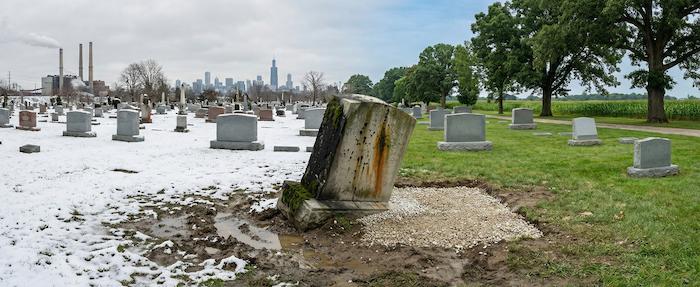
Rusting Iron Pins Split Older Monuments
Many monuments from the late 1800s and early 1900s were built in stacked pieces, typically a base and a die with a cap, sometimes topped with an urn or a cross. Stonecutters joined those pieces with iron pins set into drilled holes. Over a century, water seeps into those joints and the iron rusts. Rust takes up more space than the metal it replaces, so the pin swells inside the stone and pushes outward. A hairline crack appears at the joint first, and a rust stain bleeds down the face below it. Later the crack widens, and the top piece can loosen or shift in a strong wind. In a city with a long iron and steel history, plenty of plots still carry these old pinned monuments. Someone who reaches out about headstone repair near me for a cracked joint in Joliet usually needs the pin replaced. Patching the crack alone won't hold. Our headstone repair and restoration crew lifts the loose section, drill out the corroded pin and fit a stainless steel one. The joint is reset with a mortar suited to the stone, and the rust stain is drawn out with a poultice.
Diesel Film on Bronze Near Freight Corridors
Joliet is one of the busiest freight hubs in the Midwest. Interstates 80 and 55 cross near the city, and trucks run day and night to the warehouses and rail yards around it. Diesel exhaust leaves a fine, oily film on everything near those routes, including flat bronze markers in cemeteries along the west side. The film dulls the patina and holds dust, and the raised letters slowly lose their contrast. In winter, road salt from the same highways adds white spots on top. Ask anyone offering grave cleaners near me how they clean bronze with an oily film on it. The answer shows whether they know the metal. During bronze grave marker restoration, a degreaser that's safe for bronze lifts the film first. Then the patina is evened out by hand, and a coat of wax seals the plaque against the next season of exhaust.
Service Costs in Joliet
Joliet grave care is priced before anyone heads out. Choose the memorial type and plan on the pricing page, and that base figure is fixed with no site visit. If the technician finds more, such as a second pinned joint starting to crack, we send photos with a separate quote. That extra step waits for your approval.
- Soot crust cleaning: Low-pressure misting softens the black crust on limestone, and readable letters are repainted.
- Pinned joint repair: Corroded iron pins are replaced with stainless steel, and rust stains are drawn out.
- Bronze degreasing: Diesel film is lifted from the plaque, and the bronze is evened out and waxed.


