
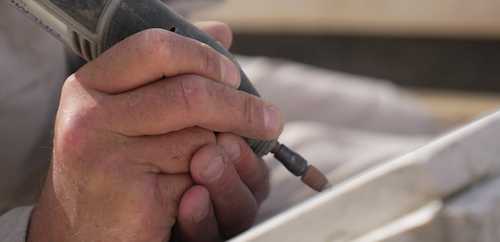
Peeling or faded headstone lettering in Illinois traces back to a different cause depending on where the stone sits. A marker near Lake Michigan loses paint to ice forcing its way under the enamel. One beside a plowed cemetery drive loses it to salt-laced grit. One over the Driftless Area's limestone aquifer loses it to hard-water residue building up in the channel. One near the southern river confluence loses it to months of standing humidity. Tending's technicians read the failure pattern in the submitted photos before quoting the repaint, and the process changes to match whichever cause actually applies. Coverage runs statewide, backed by $2,000,000 in liability insurance and membership in the ICCFA.
Ice Cleaving Near Lake Michigan
Humid air off Lake Michigan keeps carved letters in the Chicago area damp for long stretches at a time, and that moisture works into any gap in worn paint. When temperatures drop hard, sometimes well below zero during a polar vortex event, that trapped water freezes and expands inside the groove. The ice pries paint loose at the letter's edge even where the color hasn't visibly faded, and repeated freeze cycles through a single winter can strip a groove down to bare stone on their own, with no fading required at all. Force-drying the channel completely before repainting is what keeps that cycle from starting over the next winter. A polar vortex year can do more damage to a groove in a single week than an ordinary winter manages across three months.
Road Grime Worked Into the Grooves
Winter de-icing operations across northern and central Illinois kick up a fine spray of salt residue and roadway grit that settles on nearby cemetery ground. That grit works into any carved letter with worn paint, and spring rain turns it into a gritty paste that lodges in the channel and doesn't wash free on its own. Left in place, the paste keeps moisture against the enamel and speeds up the same edge-lifting that ice causes on its own. Clearing that residue before repainting matters as much as the fresh enamel itself, since fresh paint applied over leftover grit fails again within a season regardless of how carefully it goes on.
Limestone Scale in the Driftless Grooves
Groundwater in the Driftless hills of northwestern Illinois carries a heavy dissolved-mineral load from the limestone bedrock it moves through, and cemetery irrigation drawing on that water leaves a chalky film behind wherever it lands. Once that film settles into a carved letter, it can hide a date or name well before the underlying paint has actually failed. Skipping a proper degreasing step and painting straight over that film just seals the scale in underneath the new enamel, where it keeps working at the bond from below.
Humidity and Soot Near the River Confluence
Cemeteries near the Mississippi-Ohio-Wabash confluence in the state's far south sit in near-constant humidity for much of the year, and that dampness alone shortens how long enamel stays bonded inside a groove. Where coal-country soot drifts in on top of that moisture, the combination forms a dark residue that can look like fresh fading on lettering that's structurally still sound underneath. Where the same monument also shows a cracked or shifting base, that's a separate issue handled under headstone repair and monument restoration. A surface wipe alone doesn't reach the problem here. Clearing the groove down to bare stone before repainting is what actually restores the letter, and it's the same standard Tending's crews apply whether the groove is packed with soot, road grit, or plain mineral film.
Headstone Lettering Repair Costs in Illinois
Character count and groove depth are the two figures that set the price through the calculator — not ice damage, road grime, mineral scale, or humidity, and not the stone's location in the state. Photos of the existing lettering are usually enough to generate that number without a crew standing at the grave first. The finished repaint gets logged into the Tending app as a set of close-up images, so a family can review the result without making the drive out.
How Our Headstone Lettering Repair Process Works
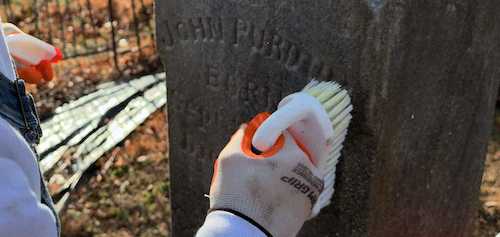
- Picking Out the Failed Pigment A technician clears each carved letter individually with a fine pick and brush, lifting out loose paint, grit, and hardened residue. Enamel that's still bonded firmly to the stone gets skipped and stays in place.
- Rinsing the Channel Clean A monument-grade solvent flushes the emptied channel to strip away grease film and any residue the hand tools couldn't reach, leaving the stone underneath clean and ready for enamel.
- Getting the Groove Bone Dry Forced-air heaters run directly into the channel until every trace of moisture is gone. Enamel applied over ground that's still even slightly damp tends to lift again well before the year is out.
- Packing the Groove With Enamel The technician packs industrial-grade enamel into the dried channel in thin layers, building each letter back up to match how deep the original carving actually runs.
- Polishing the Letters and Logging Photos Any enamel that spilled onto the surrounding stone gets buffed away with a pumice block, and a close-up photo set of the finished letters goes into Tending's app before the crew leaves the site.
