
Removing Coal Soot and Moss in Springfield
Springfield cemeteries hold a lot of history, but they also hold a lot of grime. In historic grounds like Oak Ridge, we see acres of old white marble markers that have turned black. This is a legacy of the coal industry. For decades, coal smoke settled on these porous stones. It hardened into a crust that rain cannot wash away.
The humidity in the valley makes things worse. Green algae and black mildew grow fast here. They cover the granite and eat into the limestone. Families searching for headstone cleaning services near me call us to strip off that industrial carbon crust and to kill the biological growth that makes the monuments look neglected.
Cleaning the "Black Crust"
You see this on the older monuments. The stone looks like it was dipped in tar. That is a mix of carbon soot and gypsum. It blocks the stone's pores. It traps water inside. The stone stays wet and rots.
You can't scrub it off. If you try, you take the lettering off with the dirt. The stone underneath is soft. We use a chemical poultice. We trowel a thick paste over the black areas. It sits there and softens the carbon. It pulls the stain out of the pores. We rinse the sludge away, and the stone returns to its natural white color without losing the details of the name.
Leaning Monuments in Oak Ridge
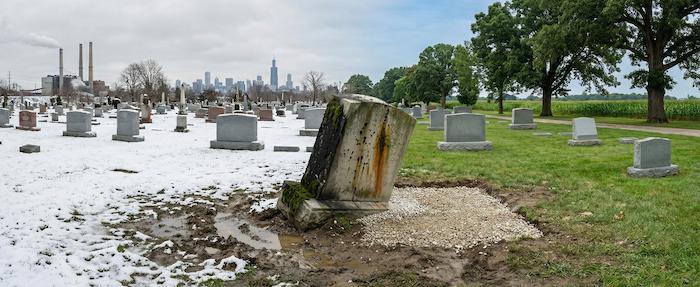
Oak Ridge Cemetery is hilly. The hills make the monuments unstable. Rain washes the soil away from the base on the downhill side. The support disappears, and the stone starts to tip.
We fix the foundation to stop the slide. We dig out the low side and jack the monument up until it is level. We pack the void with angular crushed gravel. Gravel locks together and lets the water drain through. It creates a stable platform so the monument stands straight.
"Sugaring" Marble Decay
Many markers from the 1800s are made of soft marble. Acid rain attacks the calcium in the stone. The surface bond breaks down. The stone turns sugary. If you brush your hand against it, white grains fall off.
We stop this erosion. We clean the surface gently to remove the loose sand. Then we saturate the stone with a consolidant. This fluid soaks deep into the marble and hardens. It glues the grains back together. The stone becomes solid again, preserving the inscription before it wears away completely.
Sinking in Prairie Soil
The soil here is deep, black prairie dirt. It is rich, but it is soft. Heavy flat markers sink right into it. The grass grows over the edges, and the marker vanishes.
We locate the buried stone and dig it out. Putting it back on that soft black dirt is a mistake. It will just sink again. We remove the soil and replace it with a pad of compacted gravel. This gives the stone a firm base that doesn't compress. We set the marker flush with the ground, and it stays visible.
Killing Lichen and Algae
Humidity in the Sangamon Valley feeds biological growth. We see orange lichen on the rough stone bases and green algae on the polished faces. The lichen roots grow deep into the granite.
We kill the growth before we remove it. We apply a biocide that penetrates the roots. The lichen dies and lets go of the stone. Then we wash it off with water. We get calls for cleaning granite gravestones that look like bushes. After we treat them, the stone is clean and the biological damage stops.
Restoring Bronze Plaques
Camp Butler and Roselawn have thousands of bronze markers. Time destroys the clear coat. The bare metal oxidizes and turns chalky green. You can't read the military service details anymore.
We strip the bad coating and the corrosion. We use glass beads or brushes to clean the metal down to the original brown bronze. Then we heat it and apply a new high-grade clear coat. This seals the bronze. It looks brand new and resists the weather.
Repairing Mower Damage
Cemetery maintenance crews work fast. Mowers hit the stones. We see black tire marks on the flat markers and chips on the corners of the uprights.
We remove the rubber marks with a solvent that won't hurt the polish. For chips, we can't replace the stone, but we can fix the look. We grind the sharp, broken edges down with diamond pads. Smoothing the chip blends it in and stops the mower from catching that spot again.
Service Costs in Springfield
Consolidating sugary marble takes expensive materials. Leveling a hillside monument takes a crew. We need to see the stone to give you a price. Use our online pricing tool. Pick the cemetery, upload a photo, and we give you a quote.
- Soot Removal: Stripping industrial carbon crust.
- Leveling: Resetting leaning markers on hillsides.
- Consolidation: Hardening soft, sugary marble.
- Algae Cleaning: Killing mold and lichen.


