Cleaning Mill Soot and Canal Moss in Lowell
Lowell is an industrial city. For generations, the mills smoked day and night. That smoke coated the limestone and granite markers in places like the Lowell Cemetery and St. Patrick’s. It left a thick black shell that hides the names. It isn't just surface dust; that soot is baked into the rock.
You also have the water. The Merrimack River and the canals trap humidity in the city. The fog hangs low. The stones stay wet long after the sun comes up. That is why you see so much green moss covering the markers. Families searching for headstone cleaning services near me call us to strip away that black industrial grime or to clear off the thick green growth that hides the family name.
Historic Mill Soot
The old factory smoke was greasy. It soaked into the stone and dried hard. You see white marble markers that look pitch black today. Rain runs right over it without cleaning a thing. That soot has been sitting there for a century. It is baked on solid. You can spray it with a hose all day, but it won't budge.
Regular soap does nothing here. The grime isn't just on the surface. It soaked into the pores a long time ago. We use a heavy chemical poultice. We pack the paste onto the stone and seal it. It draws the oil and carbon out of the pores chemically. When we wash the paste off later, the black goop comes with it.
Canal Dampness and Lichen
The canals make the air heavy. That wet air settles on the stones every morning. Lichen loves it. It digs roots into the rough granite and creates crusty patches that eat away at the surface.
If you scrape lichen dry, you take pieces of the stone with it. We have to kill it first. We spray it with a biological cleaner. The lichen turns to dust and releases its grip on the stone. Then it washes off naturally without damaging the marker.
Delaminating Slate
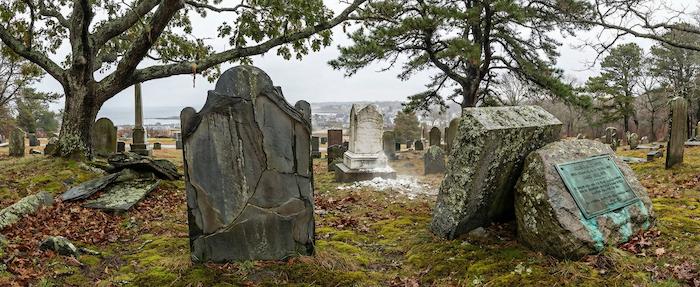
In the older grounds, like the Old English Cemetery, we see a lot of slate. Slate splits easily. Winter ice gets inside the stone and pops the face right off. You end up with a pile of chips at the bottom of the marker.
We treat slate with extreme caution. No brushes. No pressure. We use a gentle wash to clean the surface grime without disturbing the loose flakes. We want to clean the stone, not destroy it.
Frost Heave in Clay Soil
Lowell soil is mostly clay. It holds too much water. When winter hits, that wet ground freezes and pushes everything upward. The ice lifts the stones right out of place. When the ground thaws in spring, the stones don't settle back level; they end up leaning.
We fix this by excavating the clay entirely. We don't put it back in the hole. We replace it with crushed stone. Rock allows the water to run through, so the ground doesn't expand and push the marker around.
Service Costs in Lowell
Removing a century of mill soot is slow work. Stabilizing a peeling slate marker takes a steady hand. I can't give you a price without seeing the condition of the stone. We have an online tool that helps. You choose the cemetery, tell us the problem, and you get a clear price instantly.
- Soot Removal: Cleaning historic carbon buildup from mills.
- Lichen Control: Removing growth caused by canal moisture.
- Slate Care: Gentle cleaning for flaking historic markers.
- Leveling: Resetting stones moved by frost heave.