
Clay and Wind in the Summit
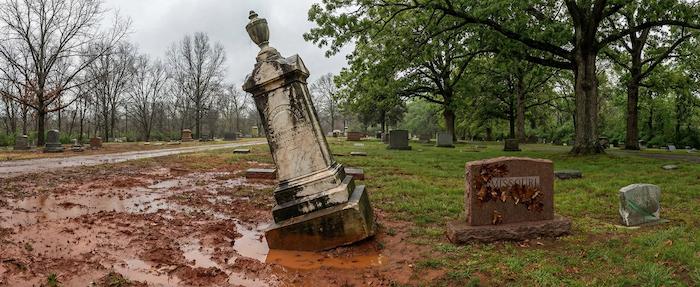
Lee's Summit sits on high ground, but the soil is heavy clay. We deal with shifting foundations and red mud staining.
In the Lee's Summit Historical Cemetery, the ground moves. Old limestone markers lean and sink. In modern parks like Floral Hills East, the wind drives dust into the bronze markers, and the sun bakes it on. Families searching for headstone cleaning services near me call us to level tipping stones and strip off the heavy oxidation that turns bronze plaques green.
Sinking in "Gumbo" Clay
The soil here is dense, sticky clay. Locals call it gumbo. It acts like a sponge.
When wet, the ground pushes up. When dry, it cracks open. This constant heaving throws stones out of alignment. We see heavy granite bases tipped sideways or sunk deep into the mud. You can't just push them back up. The clay will swallow them again. We lift the monument and dig out the soft dirt. We install a pad of angular gravel. The gravel locks together and drains the water, so the stone has a solid place to sit.
Red Clay Splash
Heavy rains splash mud onto the base of the monuments. In Lee's Summit, that mud is red clay full of iron.
It stains the stone base red, just like rust. A garden hose is useless here; the iron is set deep in the rock. We use a clay stain remover. It draws the iron particles out of the granite chemically. We rinse it off, and the red band at the bottom disappears.
Bronze Marker Oxidation
Newer cemeteries have thousands of flat bronze markers. Missouri humidity destroys the factory clear coat.
Once the coating fails, the copper oxidizes. The marker turns a chalky green. The lettering gets fuzzy and hard to read. We restore these on-site. We strip the dead coating and the corrosion. We polish the raised letters back to bright bronze. Then we spray a fresh, industrial clear coat. It seals the metal so the weather can't touch it.
Hard Water Scale
The sprinklers run nonstop in the summer. The water here is hard. It leaves white calcium deposits on the stones.
This scale creates a cloudy haze over polished granite and bronze. It hides the dates. Scrubbing doesn't help; it is like cement. We use a buffered acidic cleaner. It dissolves the mineral crust on contact. We rinse it quickly to protect the polish, leaving the stone dark and shiny.
Windblown Dust Impaction
The open fields in places like Floral Hills East are windy. The wind hammers dust into the rough granite.
The stone turns brown and dull. This isn't just surface dust; it is impacted grime. We use a pressurized steam cleaner or a chemical poultice to lift the dirt out. We force the mud out of the pores so the natural grey color of the granite comes back.
Limestone "Sugaring"
The pioneer markers in the Historical Cemetery are soft limestone. Acid rain has eaten away the binder.
The surface crumbles into white powder. If you touch it, sand falls off. We treat these fragile stones with a consolidant. The liquid soaks in and hardens the stone core. It stops the crumbling and keeps the inscription from blowing away.
Tree Sap and Pollen
Old Oak and Maple trees drop sap and pollen on the markers. The sun bakes this mixture into a hard, black varnish.
It looks like tar spots. Regular soap slides right off. We use a solvent paste. It softens the resin so we can wipe it away. We clean the stone without scratching the finish.
Service Costs in Lee's Summit
Restoring a green bronze marker takes different materials than lifting a stone out of the clay. We look at the problem first to give you an accurate price.
- Bronze Restoration: Stripping and resealing oxidized markers.
- Clay Leveling: Fixing sinking stones in heavy soil.
- Stain Removal: Cleaning red clay and tree sap.
- Consolidation: Hardening soft pioneer limestone.


