
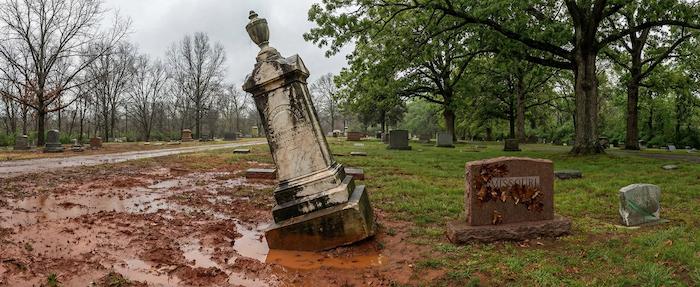
The cotton fields of Missouri's Bootheel and the sinkhole-pocked hills of the Ozark Plateau sit only a few hours apart, sharing almost nothing below the surface. Every one of Missouri's 7,248 cemeteries where Tending provides headstone cleaning and restoration falls under the same $2,000,000 liability policy and ICCFA membership that backs every visit the company makes. What threatens a headstone in one part of the state rarely matches what threatens it two hundred miles away.
How Missouri's Landscape and Industry Shape Headstone Care
The Bootheel's earthquake-prone ground works on a monument's foundation from below. Industrial haze along the I-70 corridor and lead dust from the old mining district each work on stone and bronze from above, in their own separate ways.
Bootheel Seismic Shifting and Headstone Repair
Missouri's Bootheel sits directly over the New Madrid Seismic Zone. The fault system is the source of the largest earthquakes ever recorded in the eastern United States. The 1811 and 1812 quakes rang church bells as far away as Boston, and witnesses near New Madrid reported the Mississippi itself running backward for a stretch as the riverbed buckled. Seismologists still record smaller tremors along the same fault system today. The ground beneath most Bootheel cemeteries is soft river-bottom sand and silt left behind centuries of Mississippi River flooding. A strong enough shake turns the sand briefly fluid. Geologists call this liquefaction, and the ground resettles unevenly once the shaking stops. Even a minor, unnoticed tremor loosens the fill a little further. A stone that stood level for decades can tip within a single season once the base underneath finally gives way. Tending doesn't try to re-plumb a leaning stone on ground that's still moving. The crew excavates past the loosened fill and rebuilds the base on a compacted structural footing that isn't tied to the shifting sand above it. A footing set this way is checked again after the next seismic swarm passes through the area. Headstone repair and restoration handled this way holds through the next round of tremors without needing to be redone every few years.
I-70 Industrial Haze and Bronze Marker Restoration
The stretch of I-70 linking St. Louis and Kansas City has carried Missouri's heaviest industrial traffic for more than a century, past a dense run of steel plants and automotive assembly lines in both cities. Sulfur and nitrogen compounds in the exhaust mix with moisture in the air and settle out as a mild acid over cemetery ground along the route. Bronze veterans' markers are common in this corridor's older military sections, and the acid works on the metal quickly. What starts as a normal brown patina turns dark and blotchy within a decade or two of a marker going in the ground. The corrosion won't lift with a simple wipe-down. Once a chemical treatment softens it, the metal gets worked back to its original color by hand, and Tending finishes with a fresh protective seal. Bronze marker restoration done on an I-70 corridor marker typically needs to be repeated every five to seven years, since the air along this route keeps working on the metal between visits.
Old Lead Belt Dust and Headstone Lettering Repair
Southeastern Missouri's Old Lead Belt, centered on towns like Bonne Terre and Park Hills, ranked among the most productive lead-mining districts in U.S. history from the 1720s well into the twentieth century. The St. Joseph Lead Company ran most of the district's mines through that stretch, and the crushed rock left over once the ore was extracted piled up for decades. Locals still call the mounds chat piles today, and decades of wind carried fine dust off them and across every nearby surface, headstones included. Federal cleanup crews have hauled away entire chat piles from St. Francois County in recent decades. Generations of dust had already settled into the porous stone around carved letters long before the cleanup started, and it never fully washed out on its own. In the older sections of Lead Belt cemeteries, inscriptions cut a hundred years ago are often too dark to read from a few feet away. Standard cleaning barely touches lead dust once it's ground this deep into the stone. Tending uses a poultice treatment that draws the embedded mineral particles out of the pores, working in several applications spaced weeks apart. The stone underneath usually comes back noticeably lighter, closer to the color it had before decades of dust worked into it. Headstone lettering repair finishes the job once the dust is gone, recutting any letters that had already started to soften underneath the grime.