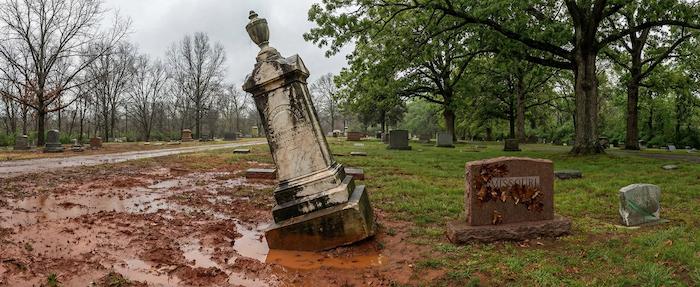
Abandoned Fireclay Mines Cause Sudden Subsidence
Long before University City filled in with brick homes and tree-lined streets, this part of St. Louis County sat above a network of underground fireclay and limestone mines, dug to supply the brick industry that built much of the region. Many of those mines were never mapped with any precision, and groundwater has spent the decades since slowly weakening the clay pillars left behind to hold up the tunnel roofs. Engineering surveys of the area note that this kind of mine subsidence can happen at any time, not on any predictable schedule tied to weather or season.
A headstone base sitting above one of these old, unmapped voids can hold steady for generations and then drop or crack once a pillar finally gives way underneath it, with no advance warning visible at the surface. Newer construction nearby has documented exactly this pattern, with clusters of settling and cracked foundations tracing the outline of a forgotten mine below. Headstone cleaning services near me searches from University City families sometimes come after exactly this kind of sudden, unexplained shift. Tending investigates the cause before resetting an affected base, since a standard reset over ground that's still actively subsiding won't hold. Work addressing subsidence at this scale falls under headstone repair and restoration.
"Great job! Thanks!"
— Amy Blue, Tending Client
Century-Old Street Trees Heave Bases in Historic Plots
University City's older neighborhoods are known for their mature street trees, many planted when the surrounding blocks were first built out nearly a century ago, and cemetery sections from the same era sit close enough to that same canopy for root systems to have spread underneath them. A root growing beneath or beside a headstone base doesn't need to touch the stone directly to move it — pressure from a thickening root a foot or two away is often enough to tilt a base over several decades. The larger and older the tree, the more likely its root system has already reached a nearby row of markers.
Bronze veterans' plaques near the same mature trees can end up cracked at their mounting points for the same reason, as ground movement from root growth pulls at fasteners that were never designed to flex. Tending resets root-affected bases and, where needed, trims the interfering root carefully enough to avoid harming the tree, then cleans and restores bronze grave markers loosened by the same movement.

Iron-Rich Clay Soil Leaves Rust Stains on Lower Stone
The same clay that made this area valuable for brickmaking carries plenty of iron, and rain splashing off that soil onto a headstone's base leaves faint rust-colored streaks that build up over years. The staining concentrates lowest on the stone, closest to the ground, and it's especially visible on lighter marble and limestone markers where the contrast is sharpest. Granite hides it better, though a close look still shows the same faint discoloration near the base. Left alone, the streaking can work its way up into engraved lettering near the base of an older monument.
Tending treats iron-stained stone with a rust-specific solution before any general cleaning happens, then recuts and repaints any lettering the staining has obscured, following headstone lettering repair standards suited to this area's clay-rich runoff.

Service Costs in University City
Pricing runs through Tending's online calculator once the monument type and care plan are selected, with no in-person visit required to assess the damage first. A maintenance plan can be added for older plots affected by mine subsidence, root heave, or iron staining, since all three tend to develop gradually. None of them announce themselves in a single visit. A recheck every few years is usually enough to catch new movement before it becomes a bigger repair.
- Base resetting and stabilization: correcting subsidence or root-related heave.
- Bronze marker repair and cleaning: restoring plaques loosened by ground movement.
- Iron stain removal and lettering repair: rust treatment and recutting for clay-runoff staining.