
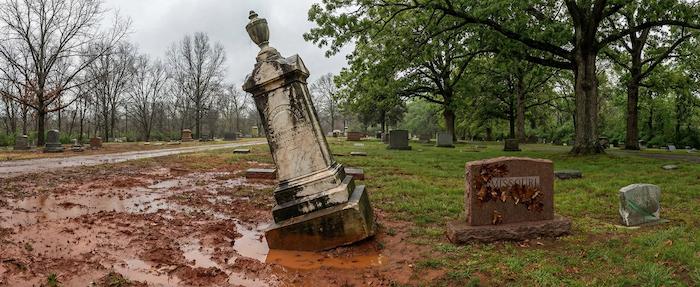
Loess-Hidden Karst Voids Undermine Rural Cemetery Ground
Western St. Louis County's rolling terrain looks solid on the surface, but a regional engineering survey notes that many of its sinkholes and caves sit hidden under a blanket of loess, the same windblown silt that covers much of this stretch of the Ozark border. Underneath that loess, groundwater keeps dissolving the dolomite and limestone bedrock the way it has for thousands of years, and soil slowly pipes down into the cracks and voids left behind. The process is gradual and invisible from above until a section of ground finally gives way.
A headstone base near one of these developing voids can look completely stable for years and then drop suddenly once the piping beneath it reaches a tipping point, which is a different pattern than the slow lean caused by ordinary soil movement. Neighboring markers in the same row, sitting over solid bedrock, may show no sign of trouble at all. Headstone cleaning services near me searches from Wildwood's rural cemeteries sometimes come from families who describe a stone that seemed fine at the last visit and isn't now. Tending checks for signs of active soil piping before resetting an affected base, since a standard reset over a still-developing void won't hold for long. Larger structural repairs are covered under headstone repair and restoration.
Meramec River Floods Scour Low-Lying Stone and Metal
The Meramec River, which drains much of this part of the county, produced two record-breaking floods within sixteen months of each other in 2015 and 2017, each one setting new all-time high-water marks in communities along its banks. Floodwater moving at that kind of volume doesn't just leave silt behind — it carries enough debris and force to physically scour a stone's surface, leaving a rougher, duller finish than typical mud staining produces. Plots in low-lying sections nearest the river bottom show this most, and a single major flood event can undo years of otherwise routine upkeep in one pass.
Bronze veterans' plaques in the same flood path pick up similar scouring along with a layer of settled sediment. Tending treats flood-scoured stone with a restoration approach built for physical surface damage. Staining alone is a simpler fix, and this calls for more. The same visit covers cleaning and restoring bronze grave markers affected by the same flood events.

Karst Spring Dampness Deepens Moss and Lichen on Shaded Stone
Wildwood's rural cemeteries sit among the oak-hickory forest and spring-fed hollows typical of this part of the Ozark border, and karst springs keep the ground in these shaded areas damp well after the surrounding land has dried out. That persistent moisture, combined with heavy tree cover, gives moss and lichen a head start most drier cemeteries don't have, and older markers under mature canopy often carry a thicker growth than similar stones out in open ground nearby. A family plot tucked into one of the area's wooded hollows near Rockwoods or Greensfelder can stay noticeably damper than a plot just a short distance away on higher, more open ground. Engraved lettering under that growth becomes hard to read even before the carving itself shows any real wear.
"I cannot express how much I appreciate the hard work that they did to my mom's head stone. My mother was my whole life , and I can't get there to clean it up and i'm so happy that I found tending. It looks absolutely brand new.I couldn't be happier and I would recommend them to anyone"
— Crazy Catlady, Tending Client
Tending clears moss and lichen with a soft-wash biocide suited to karst-fed dampness, then recuts and repaints any lettering that's gone shallow underneath, following headstone lettering repair standards adjusted for consistently damp, shaded ground.
Service Costs in Wildwood
Pricing runs through Tending's online calculator once the monument type and care plan are selected, with no in-person visit required to assess the damage first. A maintenance plan can be added for rural plots affected by karst subsidence, flooding, or persistent shade.
- Base resetting and stabilization: correcting settling from active karst subsidence.
- Flood damage restoration: treatment for scoured stone and bronze from Meramec River flooding.
- Moss and lichen removal with lettering repair: biocide cleaning and recutting for shaded, damp plots.