
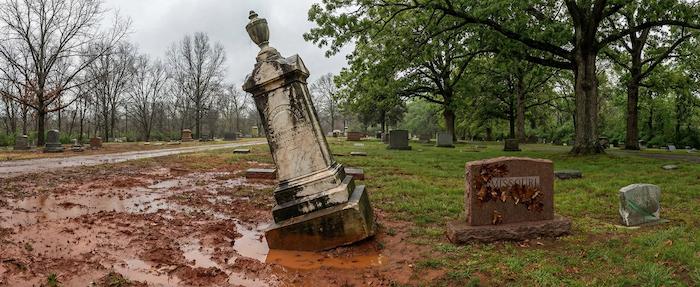
Fishpot Creek Erosion Settles Streamside Headstones
Ballwin drains toward the Meramec River through Fishpot Creek, one of several smaller tributaries that cut through the area's clay-heavy till on their way south, and a handful of the city's older church cemeteries sit close enough to these creek banks to feel the effects of that erosion firsthand. Unlike a major river, Fishpot Creek doesn't need a historic flood to reshape its banks — routine heavy rain moves enough soil most years to gradually undercut ground near the water's edge.
Erosion along a creek bank rarely announces itself all at once. The ground supporting a nearby headstone thins out gradually, a little more with every hard rain, until the stone finally leans in whichever direction lost the most soil. By the time a family notices anything unusual, the process has typically been underway for years already. Headstone cleaning services near me searches from Ballwin's creekside cemeteries sometimes turn up exactly this situation, a stone that's clearly moved but shows no cracking or damage to explain why. Tending traces the movement back to the creek bank itself before touching the base, since fixing the lean without stopping the erosion just buys a season or two before the stone drifts again. Correcting a lean this far along falls under headstone repair and restoration.
"Tending not only restores headstones, they clean up graveyards. They do a wonderful job and I can’t recommend them highly enough!"
— Beatle, Tending Client
Sulphur Spring Groundwater Blackens Bronze Markers
Ballwin has at least one historic sulphur spring nearby, enough to have given a local road its name, and groundwater carrying trace hydrogen sulfide isn't unusual in this part of the county. That sulfide reacts with bronze far more aggressively than ordinary weathering does, forming a hard black tarnish. That's different from the familiar green patina bronze usually develops elsewhere. A veterans' plaque exposed to sulfide-bearing groundwater can darken to nearly black within a matter of years, well ahead of a comparable plaque in drier, sulfide-free soil. Family members sometimes assume the marker has simply gone dirty, when the real cause is a chemical reaction with the metal itself.
Standard bronze cleaning methods built for green patina don't fully address this black sulfide tarnish, since the chemistry involved is different. Tending treats sulfide-blackened bronze with a formula matched to that specific reaction, restoring the plaque's detail without stripping the metal's protective surface, and cleans and restores bronze grave markers affected by this groundwater on the same visit. A plaque treated this way generally holds its restored finish for years before the surrounding soil chemistry catches up with it again.
Clay Till Freeze-Thaw Wears Down Older Lettering
The dense clay till underlying most of Ballwin swells when saturated and pulls back tight as it dries, and that repeated movement, paired with Missouri's regular freeze-thaw cycles, works into hairline cracks on older marble and limestone markers over the decades. Engraved lettering on these older stones, many tied to the area's original German Methodist and Lutheran congregations, tends to wear shallow well before comparable granite markers show similar age. A name still crisp on a granite marker from the same decade can already be difficult to read on the marble stone next to it.
Tending recuts and repaints lettering worn down by this pattern, following headstone lettering repair standards suited to the region's older marble and limestone monuments. Granite markers rarely need this same level of intervention, even at a comparable age.
Service Costs in Ballwin
Pricing runs through Tending's online calculator once the monument type and care plan are selected, with no in-person visit required to assess the damage first. A maintenance plan can be added for markers along Fishpot Creek or affected by sulfide groundwater, since both tend to develop gradually. Neither one shows up as a single, obvious event. A periodic check catches either one early, well before a full reset or retreatment becomes necessary.

- Base resetting and stabilization: correcting lean from creek bank erosion.
- Sulfide tarnish removal: specialized treatment for blackened bronze markers.
- lettering repair: recutting engraving worn by clay-driven freeze-thaw cycles.