
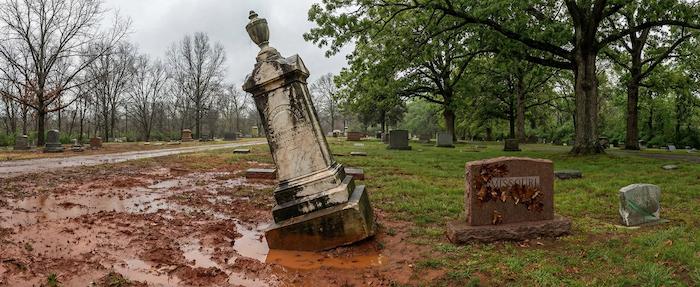
Ancient Glacial Clay Heaves Rural Headstones
Pre-Illinoian glaciers pushed as far south as Clay County before retreating, and the till they left behind has had hundreds of thousands of years since to weather into some of the most expansive clay in the region. Studies of this specific till formation put its expandable clay content near 40 percent, well above what typical Missouri clay soils carry, and that clay swells when saturated and pulls back tight once it dries. Liberty's many small, scattered family cemeteries, most of them carved out of what used to be farmland, sit directly on this till.
A headstone base set into this kind of clay takes a stronger push with every wet-dry cycle than it would almost anywhere else in the state, and older upright markers in Liberty's rural plots often show a more pronounced lean than similarly aged stones elsewhere in the county. Flat, ground-level markers tend to shift less dramatically but still settle unevenly, since the till underneath them doesn't move at the same rate in every spot. Headstone cleaning services near me searches from these family cemeteries often start once a relative notices a stone that's shifted well out of plumb. Tending resets affected bases on a bed of compacted gravel that gives the clay room to move without pushing directly on the stone. Structural resets of this kind fall under headstone repair and restoration.
Pennsylvanian Coal Seams Leave Sulfur-Tinged Staining
The bedrock under Clay County includes thin, interbedded seams of coal alongside its limestone and shale, laid down in cycles hundreds of millions of years ago and mined on a small scale in parts of the region. Those coal seams carry sulfide minerals that react with air and water much the way they do in any coal-bearing rock, producing a mildly acidic runoff that leaves a faint yellow-to-brown stain wherever it reaches a nearby headstone. The discoloration tends to show up first on lighter marble and limestone markers, where it stands out against the pale stone, and it typically starts low near the base before working its way upward over years.
Bronze veterans' plaques near the same runoff path can develop a similar tinted patina, distinct from the plain green corrosion bronze usually shows. Tending treats sulfur-tinged staining with a solution matched to that specific chemistry, and cleans and restores bronze grave markers affected by the same coal-seam runoff on the same visit.
Mature Trees in Rural Plots Deepen Algae and Lichen Growth
Many of Liberty's family cemeteries sit tucked into small groves of mature oak and hickory, remnants of the woodlots early farms left standing at field edges, and that canopy keeps the ground beneath it damp well after open pasture nearby has dried out. Algae takes hold on the shaded, north-facing side of a headstone first, and lichen follows once enough organic buildup gives it a foothold. Engraved lettering under a heavy growth of either one becomes difficult to read long before the carving itself shows real wear.

A soft-wash biocide treatment lifts algae from the base first, then works on the lichen higher up the stone where it's had longer to set in. Tending follows that cleaning with lettering repairs wherever the growth has already left the engraving shallow, recutting and repainting to match the stone's original depth. The work follows headstone lettering repair standards built for markers that spend most of the year under heavy tree cover.
Service Costs in Liberty
Pricing runs through Tending's online calculator once the monument type and care plan are selected, with no in-person visit required to assess the damage first. A maintenance plan can be added for rural family plots affected by clay heave, coal-seam staining, or heavy shade, since all three tend to worsen gradually across seasons. None of them resolve on their own.
"I was absolutely amazed at what they were able to achieve with the headstones. Aged stones that I had tried to clean personally and got nowhere with looked fantastic. The detail that went with the stones being cleaned was thorough. I ended up having a total of eight stones done because I was so happy with the work. I cannot recommend highly enough!"
— Laverne S, Tending Client
- Base resetting and stabilization: correcting heave from expansive glacial clay.
- Sulfur stain and bronze treatment: chemistry-matched cleaning for coal-seam runoff.
- Algae and lichen removal with lettering repair: biocide cleaning and recutting for shaded plots.