Interbedded Shale Layers Let Sloped Ground Creep
The limestone under Raytown formed in alternating bands with shale, a stacked sequence geologists call a cyclothem, and one of those limestone bands is literally named the Raytown member after this exact area. The shale layers between the limestone beds are thin and fissile. Wet, they turn famously slick, and on sloped ground they act as a slip plane that lets everything above them creep slowly downhill. Local geology reports describe these shale partings showing up as slumping, vegetated hillsides once enough soil has built up over them.
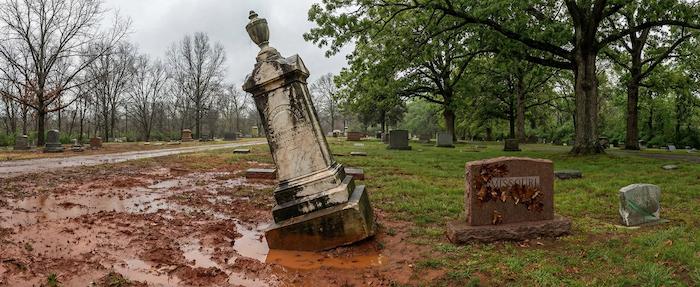
A headstone base set into ground with one of these shale layers not far below the surface can drift out of plumb even without any dramatic soil movement of its own. The whole slope underneath it is inching downhill a fraction of an inch at a time. Headstone cleaning services near me searches from Raytown's hillside cemeteries sometimes come after a family notices a row of markers all leaning the same direction, a telltale sign of slope creep. That pattern doesn't look like isolated settling. Tending resets affected bases on a footing designed to resist that slow downhill pull, anchoring deeper into more stable ground below the shale parting where possible. Anchoring a base against ongoing slope creep falls under headstone repair and restoration.
Fossil-Rich Local Limestone Weathers Into Blotchy Patches
The Raytown limestone that gives this area its name is known locally as the "Calico ledge" for its mottled, spotted appearance, a pattern created by dense clusters of fossilized shells packed unevenly through the rock. Markers cut from this or similar local stone inherit that same unevenness, and weathering doesn't wear the surface down at a uniform rate — the fossil-dense patches erode differently than the surrounding matrix, and the blotchy look deepens over decades. It never really smooths out. Two stones cut from the same quarry batch can end up looking noticeably different once weathering has had a few decades to work on each one.

Bronze veterans' plaques set into the same fossiliferous stone bases can develop patchy staining for a related reason, as mineral-rich water moving through the uneven limestone reaches some spots on the metal before others. Tending treats blotchy limestone weathering with a leveling technique suited to uneven stone, and cleans and restores bronze grave markers affected by the same irregular mineral exposure on the same visit. Getting an even result on this kind of stone takes more attention than cleaning a uniform granite surface.
"Dachi and team were kind enough to get our son’s headstone cleaned in time for his birthday. Really great people to work with and highly recommend."
— SK, Tending Client
Continental Freeze-Thaw Wears Lettering on Older Markers
Kansas City's inland, continental climate swings hard between summer heat and winter cold, and that swing brings plenty of freeze-thaw cycling to older monuments each year. Water finds its way into the same hairline cracks that develop along a stone's natural bedding, and each freeze widens those cracks a little further. Water works into the same hairline cracks on markers cut from local limestone or older marble, and each freeze widens them a little more. Lettering on those stones goes shallow years ahead of the surrounding wear, since granite nearby has no comparable bedding planes for water to exploit.

A recut-and-repaint pass brings that lettering back to a legible depth, done to headstone lettering repair standards suited to the region's mix of local limestone and imported marble monuments. Granite markers from the same era rarely need this same depth of intervention.
Service Costs in Raytown
Pricing runs through Tending's online calculator once the monument type and care plan are selected, with no in-person visit required to assess the damage first. A maintenance plan can be added for markers affected by slope creep, blotchy weathering, or freeze-thaw wear, since all three tend to develop gradually across many seasons.
- Base resetting and stabilization: correcting lean from shale-layer slope creep.
- Limestone leveling and bronze cleaning: treatment for blotchy fossiliferous stone and metal.
- lettering repair: recutting engraving worn by regional freeze-thaw cycles.