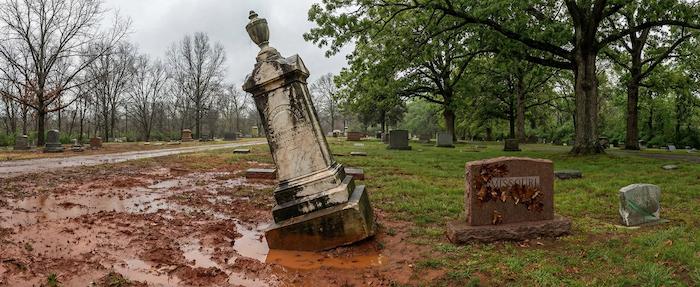
Backfilled Railroad-Era Quarry Pits Settle Unevenly
Kirkwood grew up around the Pacific Railroad in the 1850s, and building that line meant quarrying local limestone for ballast and foundations. Some of that same stone went into the nearby Barretts Tunnels, the first railroad tunnels built west of the Mississippi. Many of the smaller quarry pits opened for that work were later backfilled with loose rubble and soil once the stone was no longer needed, and some of that fill sits under parts of the city today with no clear record of exactly where. Loose backfill compacts at a different rate than the natural ground around it, sometimes for a century or more after it was placed.
A headstone base set into one of these old backfilled areas can settle unevenly compared to a neighboring marker on undisturbed ground just a few feet away, with no obvious surface clue to explain the difference. Old plat maps and construction records from the 1850s rarely noted the exact boundaries of these smaller pits, so the safest approach today is treating any unexplained settling as a possible fill issue until proven otherwise. Headstone cleaning services near me searches from Kirkwood's older cemeteries sometimes come after a family notices a stone that's dropped more than the others nearby. Tending checks the fill history of an affected plot before resetting the base, since compacting backfill needs a different footing approach than solid native soil. Resetting a base over old backfill falls under headstone repair and restoration.
Urbanized Deer Creek Runoff Scours Nearby Plots
More than a century and a half of dense development has covered much of Kirkwood's share of the Deer Creek watershed in rooftops and pavement. All that hard surface sends storm runoff into the creek fast, with none of the give the natural ground once had. What used to be a gentle rural stream now rises and falls quickly after a heavy rain, moving with enough force near its banks to scour soil away from cemetery plots that back up to the water. The change happened gradually as the suburb built out, which means the erosion risk has grown right along with the neighborhood itself.
Bronze veterans' plaques near the same stretch of creek pick up sediment and occasional scouring from the same fast-moving runoff. Tending treats scoured, sediment-affected stone with an approach built for physical surface wear — scouring like this needs more than a standard wash to fix properly. The same visit covers cleaning and restoring bronze grave markers affected by the same urban runoff.
"This is my first experience, and they have entrusted me with their loyalty. No question goes unanswered, and their delivery and performance are excellent."
— GaryD, Tending Client
Urban Heat Island Effects Deepen Freeze-Thaw on Lettering
Dense pavement and close-set buildings in Kirkwood's historic core hold and release heat differently than open, rural ground does, and that creates sharper daily temperature swings right around older, in-town cemeteries than the surrounding countryside typically sees. A stone near a parking lot or busy street can swing through more freeze-thaw cycles across a winter than one out in a quieter setting, even a few miles away, since it's warming and cooling on the urban environment's own schedule. The season alone doesn't set the pace here.
Tending recuts and repaints lettering worn shallow by this urban freeze-thaw pattern, following headstone lettering repair standards adjusted for markers in Kirkwood's older, more built-up sections.

Service Costs in Kirkwood
Pricing runs through Tending's online calculator once the monument type and care plan are selected, with no in-person visit required to assess the damage first. A maintenance plan can be added for plots affected by old quarry fill, creek runoff, or urban freeze-thaw exposure, since all three conditions tend to persist across many seasons. None of them resolve after a single visit.

- Base resetting and stabilization: correcting settlement from backfilled quarry ground.
- Sediment and abrasion cleanup: restoring stone and bronze scoured by fast urban runoff.
- lettering repair: recutting engraving worn by urban heat-island freeze-thaw cycles.