
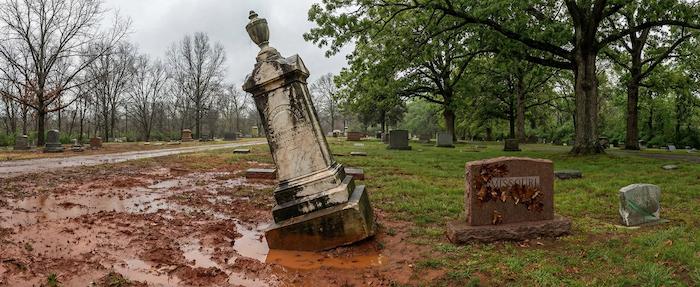
Peoria Loess Collapses Under Bluff-Top Headstones
The Ozark Escarpment drops down into the Mississippi River lowlands right at Cape Girardeau, and the uplands on that Ozark side are capped with Peoria Loess, a thick blanket of windblown silt left over from the last ice age. Loess holds its shape remarkably well when it's dry, standing in nearly vertical faces the way it does along many of the region's road cuts, but that same structure depends entirely on staying dry. Once heavy rain saturates it, the tiny mineral bridges holding the silt grains together give way all at once, and the ground doesn't just settle — it collapses.
"I was absolutely amazed at what they were able to achieve with the headstones. Aged stones that I had tried to clean personally and got nowhere with looked fantastic. The detail that went with the stones being cleaned was thorough. I ended up having a total of eight stones done because I was so happy with the work. I cannot recommend highly enough!"
— Laverne S, Tending Client
A headstone base set into loess-capped ground can sit stable for years and then drop several inches after a single wet season, which looks alarming compared to the slow, gradual settling seen in clay soils elsewhere. Family members are often surprised that a marker changed so much between visits, since nothing about it looked unstable the last time anyone checked. Headstone cleaning services near me searches from Cape Girardeau's bluff-top cemeteries sometimes come after exactly this kind of sudden shift. Tending resets loess-affected bases on a compacted footing engineered to resist saturation-driven collapse. Leveling the visible tilt alone won't stop it from happening again. Larger structural repairs are covered under headstone repair and restoration.

Mississippi River Flooding Leaves Silt on Bottomland Plots
Cape Girardeau's relationship with the Mississippi is serious enough that the city built a floodwall along its riverfront after decades of damaging high water, and the older cemeteries sitting in the lower bottomland outside that protected zone still take the brunt of periodic flooding. When the river rises into these areas, it leaves behind a layer of fine alluvial silt once it recedes, a dense, clay-like film that's considerably harder to remove than ordinary surface dirt. Plots closest to the old river channel tend to see this most, since they sit lowest relative to the current floodwall line.
Bronze veterans' plaques in the same flood-prone plots pick up the same silt coating and lose their shine under it. Tending clears river silt with a soft-wash method suited to dense alluvial buildup, and cleans and restores bronze grave markers caught in the same flood zone on the same visit.

Limestone Bluff Springs Deposit Mineral Crust on Nearby Stone
The limestone and dolomite bluffs framing parts of Cape Girardeau are riddled with the springs and seeps typical of karst country, and water emerging from those springs carries dissolved calcium picked up on its way through the rock. Where a headstone sits close enough to catch runoff from one of these seeps, that mineral-rich water evaporates and leaves behind a hard, travertine-like crust, a different animal than ordinary grime, since it builds up in layers. A loose film of dirt never does that. Engraved lettering under a thick enough layer of this crust becomes difficult to read, even though the carving underneath hasn't actually worn away.
Tending removes travertine-style crust with a treatment built for calcium carbonate buildup, then recuts and repaints any lettering left shallow underneath, following headstone lettering repair standards suited to spring-fed mineral deposits. A stone treated once rarely needs the full crust-removal process again for several years, though a light rinse on a maintenance visit keeps new buildup from taking hold.
Service Costs in Cape Girardeau
Pricing runs through Tending's online calculator once the monument type and care plan are selected, with no in-person visit required to assess the damage first. A maintenance plan can be added for bottomland or bluff-adjacent plots that need periodic checks, since both loess collapse and spring-fed mineral buildup tend to develop gradually between visits.
- Base resetting and stabilization: correcting collapse from saturated loess ground.
- River silt and bronze cleaning: soft-wash removal of alluvial buildup from stone and metal.
- Mineral crust removal and lettering repair: treatment for spring-fed travertine deposits.