
Stone Care on the Ozark Plateau
Springfield is built on karst. The ground here is full of holes, caves, and chert rock. That makes cemetery maintenance tricky.
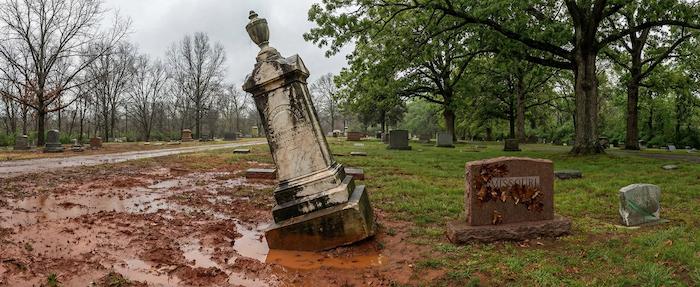
In historic places like Maple Park or Hazelwood, the ground shifts unexpectedly. Sinkholes open up; underground streams wash away foundations. Families searching for headstone cleaning services near me often find their monuments tipping over or sinking into a void. We deal with the rocky soil, the sinkholes, and the biological growth that thrives in our humid Ozark climate.
The Karst Drainage Problem
Water doesn't just run off here; it goes down. Our karst topography means underground drainage can wash the soil right out from under a heavy monument.
We see stones that looked fine yesterday tipping dangerously today because a pocket opened up underneath. You can't just pack dirt back in. We excavate the hole. We use jagged, angular gravel that locks together. We build a bridge over the unstable ground so the monument has a solid footer that won't disappear into a sinkhole.
Chert and Rocky Soil
Digging in Springfield is a fight. The ground is full of sharp flint rocks.
These rocks create air pockets around the headstone bases. Water pools in the gaps and freezes against the stone. When we relevel a marker, we screen the dirt. We replace the rocky soil with clean, compactable sand and gravel. This gives the stone a smooth bed that doesn't heave when the ground freezes.
"Sugaring" of Burlington Limestone
Many pioneer markers are cut from local Burlington limestone. It is white and beautiful, but it is soft.
Acid rain eats the binder in the stone. The surface turns to powder. If you brush it, you brush away the name. We call this "sugaring." We treat these stones with a chemical consolidant. It soaks deep into the pores and re-hardens the stone. It stops the dusting and saves the history before it blows away.
Pine Pitch and Maple Sap
Cemeteries like Greenlawn are full of old trees. Short-leaf Pines and Silver Maples drop a lot of sap.
That sticky pitch lands on the headstone and bakes in the sun. It turns into hard, amber beads that attract black dirt. You can't scrape it; you'll chip the stone. We use a solvent spot treatment. It melts the resin so we can wipe it away without harming the granite polish.
Red Clay Stains
Beneath the topsoil, we hit heavy red clay. When it rains hard, that red mud splashes on the stone.
It dyes the base of the marker red. It looks like rust. You can scrub all day, but the stain stays put. We use a specialized clay remover. It lifts the red iron particles out of the stone pores. We pressure rinse it (low pressure) to get the white sparkle back in the marble.
Moss in Shaded Valleys
In low spots like St. Mary's, the air stays wet. Moss takes over the north side of the markers.
Moss keeps the stone wet. In January, that water turns to ice and pops the face of the stone off. We kill the moss with a biocide. We don't wire-brush it; that ruins the finish. The cleaner kills the roots. Rain washes the dead debris away, leaving the granite clean.
Black Walnut Ink
Walnut husks are a plague in local cemeteries. They drop in the fall and leave pitch-black stains.
It looks like spilled ink. This is a dye, not dirt. We use a poultice paste. We spread it over the black spot and cover it. It draws the walnut dye out of the rock over 24 hours.
Service Costs in Springfield
Stabilizing a stone in karst terrain takes more material than a standard leveling job. We have to make sure the ground is solid. We inspect the site to give you a fair price.
- Karst Stabilization: Fixing sinking stones in unstable soil.
- Consolidation: Hardening soft, sugary limestone.
- Sap Removal: Cleaning pine pitch and maple syrup.
- Clay Cleaning: Removing red mud stains from bases.


