

Cleaning Rough Granite and Fixing Frost Heaves in Concord
Concord is famous for granite. The local quarries supplied the stone for half the monuments in New England. But if you walk through Blossom Hill or Old North Cemetery, you see the problem with that local stone. The rough, rock-pitched edges act like Velcro for dirt and lichen. We see heavy grey and orange growth that digs deep into the texture of the rock. It makes the stones look dark and neglected.
The other issue is the winter. The ground here freezes hard and goes deep. It doesn't just get cold; the earth actually moves. It shoves foundations upward and tips the headstones over. We see upright monuments leaning dangerously and flat markers that have completely disappeared into the mud during the spring thaw. Families searching for headstone cleaning services near me call us to kill that stubborn lichen, scrub the quarry dust out of the crevices, and reset the stones that the winter moved.
Cleaning Rough-Cut Granite
Most monuments in Concord have "rock-pitch" edges—that rough, natural look. It looks good when it's new, but it traps everything. Pollen, moss, and soot get stuck in the jagged surface. You can't just hose it off.
We kill the growth with a biological cleaner. Once the moss dies, we have to scrub. The dirt is trapped deep in the rough texture. We force the bristles into the jagged pits. You have to scrub from multiple angles to break the dirt loose. It is physical work, but it clears the stone down to the grain.
Resetting Frost-Heaved Monuments
New Hampshire winters move the earth. We see heavy granite bases that have tipped over because the ground heaved underneath them. If a stone leans too far, the pins snap, and the die (the top part) falls off.
We fix the lean by fixing the ground. We hoist the stone up. We dig out the dirt that freezes and holds water. We fill the hole with crushed angular stone. This gravel pad doesn't hold water, so it doesn't heave. We set the monument back down, and it sits flat.
Removing "Black Crust" from Marble
In the older sections of Old North, the white marble markers are black. That isn't simple dirt. It is a gypsum crust caused by decades of sulfur in the air reacting with the stone. It forms a hard shell that traps moisture inside the marker.
We use a chemical poultice to remove it. We apply a thick paste that sits on the crust and softens it. It draws the sulfur out. We rinse the paste away, and the black sludge comes with it. The marble comes out white again, and we didn't have to use a scraper.
Killing Hard Lichen
Lichen loves granite. It forms hard, crusty circles that bond to the silica in the stone. If you try to scrape them off dry, you will scratch the polish and leave the roots behind.
We kill it. We soak the stone with a biocide. The lichen turns soft and releases its grip on the rock. Then we brush it off. Kill the root, and the stone stays clean.
Lifting Sunken Flat Markers
The soil gets soft here in April. Heavy flat markers sink. We find veteran markers that are buried under three inches of sod and mud.
We cut the grass back to find the edges. We pry the stone up out of the wet dirt. We pack the hole with gravel for drainage and reset the stone. It sits flush with the grass, but on a solid base that won't sink.
Removing Pine Pitch
The white pines in Concord drop sticky sap all summer. It lands on the headstones and hardens into black bumps. Dirt sticks to it.
We use a solvent to dissolve the pitch. We dab it on the spots until the resin melts. We wipe it up. It cleans the stone without damaging the polished finish.
Service Costs in Concord
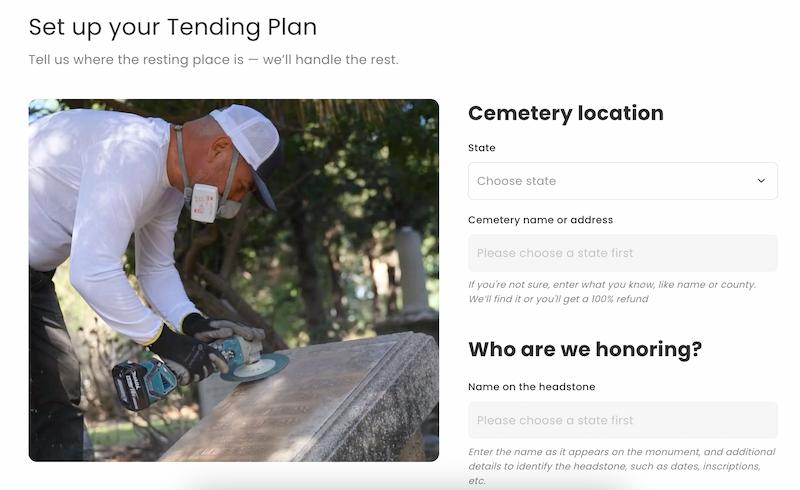
We have flat-rate pricing for Concord, Bow, and Pembroke. We don't need to visit the cemetery to give you a price. Check our subscription builder to see the exact cost for your plot.
- Granite Cleaning: Scrubbing rough-cut stone.
- Leveling: Resetting frost-heaved monuments.
- Crust Removal: Cleaning historic marble.
- Marker Lifting: Raising sunken flat stones.