
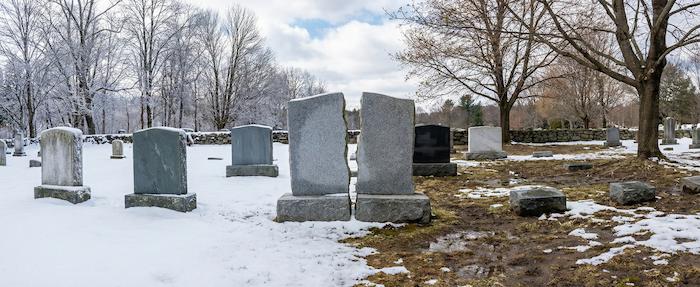
A Concord granite headstone in a central New Hampshire cemetery can split clean through the middle after one hard freeze, when water trapped in a hairline crack expands hard enough to pop the stone apart; a bronze veteran's plaque near the short stretch of coast around Portsmouth corrodes from road salt and sea spray instead, with no ice fracture involved. New Hampshire counts 970 cemeteries statewide, and every headstone cleaning visit Tending makes there carries the same $2,000,000 liability policy and ICCFA membership. Which fix actually helps a New Hampshire headstone depends on what's really behind the damage.
How New Hampshire's Granite and Cold Shape Headstone Care
New Hampshire's own Concord granite, quarried for generations to build some of the country's best-known monuments, is just as vulnerable to a hard freeze as any other stone once water finds its way inside a crack. Sugar maples common across the state's older cemeteries drip sap that settles directly into engraved letters each spring, and winter road salt reaches bronze markers near well-traveled routes through its own separate chemistry.
Concord Granite Ice Fracture and Headstone Repair
New Hampshire earned its nickname, the Granite State, from Concord Gray granite quarried out of Rattlesnake Hill since 1883, stone strong enough to build the Library of Congress, parts of the Washington Monument, and the New Hampshire State House itself. That granite still faces one threat no quarry can engineer around: water working into a hairline crack and freezing there. Water expands by roughly nine percent the moment it turns to ice, and there's nowhere for that extra volume to go inside a solid block of stone except outward, against the crack's own walls. A crack that starts as a hairline in November can run the full width of a headstone by spring, after enough nights below zero to freeze and refreeze the water inside it dozens of times. Frost also works underneath a monument's base during New Hampshire's spring mud season, when the top layer of ground thaws to soft mud while deeper soil stays frozen solid, and a heavy stone can tip or sink as the unstable layer shifts underneath it. Tending repairs a split block by drilling into the broken pieces and pinning them back together with steel rods set in an epoxy made to move with the stone through the next freeze without cracking again. Headstone repair on a mud-season monument means digging past the unstable layer and packing the excavation with gravel deep enough to drain water before it can freeze and heave the base again.
New Hampshire Maple Sap and Headstone Lettering Repair
Sugar maples line the stone walls of cemeteries across New Hampshire, planted generations ago for shade and, in many towns, still tapped every spring for maple syrup. The same trees that produce syrup also drip sap directly onto whatever sits underneath them, and a headstone under a mature sugar maple collects a steady drizzle through the entire spring sap run. Sap that lands in an engraved letter cooks hard in the sun within days, turning into a black, glassy residue that fills the groove and covers whatever paint is underneath it. Scraping the hardened sap out with a blade cuts into the surrounding polish just as easily as it cuts into the sap itself, leaving permanent scratches next to whatever letter someone was trying to clear. Windblown maple seeds, the winged samaras that drop by the thousands in early summer, pile up wet against a monument's base and rot there if nobody clears them, holding moisture against the stone long after the sap itself has been dealt with. A solvent made for hardened tree resin melts the sap back into a liquid without any scraping, and headstone lettering repair repaints whatever letter the sap had covered once the groove is fully clear.
New Hampshire Road Salt and Bronze Marker Restoration
New Hampshire's short Atlantic coastline around Portsmouth brings sea spray to a handful of cemeteries. Road salt reaches bronze markers statewide, since every winter road crew salts highways running past rural cemetery after rural cemetery. Plow trucks throw salt spray well past the road shoulder, and the brine soaks into porous granite and bronze fittings alike near any well-traveled route. Chlorides in the salt react directly with the copper in a bronze alloy, and a plaque near a heavily salted highway can turn dark and blotchy within a decade or two. Salt also works into the joint between a bronze plaque and its granite backing, breaking down the mortar originally used to set it in place. A chloride-neutralizing rinse stops the corrosion before it eats any deeper into the metal, and bronze marker restoration reseals the surface afterward with a finish made to hold up against continued road-salt exposure.