The Salt Air Problem
You can smell the salt in the air almost anywhere in this state. That ocean dampness settles on the cemeteries every morning. It leaves a salty film on the headstones that never really dries out.
That salt eats into everything. On granite, it dulls the polish. On concrete bases, it causes them to crumble. We flush the stones with fresh water and a chemical neutralizer. You have to get that salt out of the pores, or it will just keep eating the stone from the inside out, winter after winter.
Historic Slate Splitting
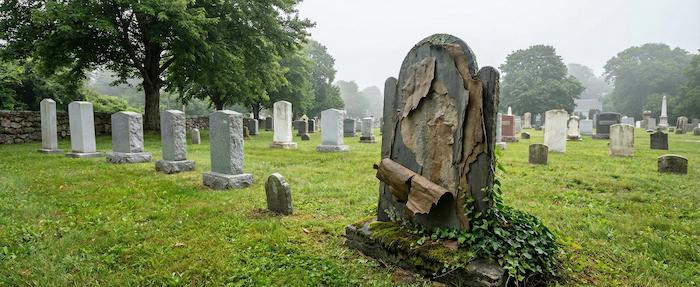
Newport and Providence have some of the oldest slate markers in the country. Slate is just layers of compressed mud. Over three centuries, water works its way into the edges and forces those layers apart.
We see the faces of these stones peeling off like wet cardboard. You cannot seal them with silicone; that traps the water inside. For tombstone repair and restoration, we clean out the gaps and inject a flowable grout. We clamp the stone tight until it bonds. Then we cap the top edge to stop the rain from getting back in.
Green Mold and Algae
Rhode Island is humid. The cemeteries here, especially the ones with big shade trees, turn green fast. We deal with thick algae and mold growing on every surface.
Scrubbing this stuff dry is a bad idea. It just grinds the spores into the rock. We use a biological liquid cleaner. We spray it on and let it soak. It kills the mold at the root. It takes a few days, but the growth dies off and releases its grip. It gets the stone clean without us having to scrape it raw.
Bronze Corrosion
Salt air wrecks bronze. We see veteran markers that have turned completely chalky green. The metal is oxidizing. If you leave it, the lettering dissolves.
We restore these by hand. We strip off the failed coating and the green corrosion. We get down to the stable metal. Then we heat the bronze and apply a specialized hot wax. It seals the metal. It keeps the salt air off the surface so the marker stays dark and readable.
Urban Soot and Grime
In the industrial parts of Providence and Pawtucket, the older stones are black. That isn't mold; it's a century of coal smoke and exhaust fumes. It forms a hard crust.
This crust bonds to the limestone. Water won't touch it. We use a poultice paste for headstone cleaning services. We smear it over the black spots and cover it. It pulls that deep black stain right out of the pores. We hose it off, and the original white stone finally shows through.
Marble "Sugaring"
Acid rain hits our old white marble hard. The acid eats the bond holding the crystals together. If you run your hand over it, it feels loose and sugary.
The stone is falling apart. High pressure water will blow the details right off. We treat these stones with extreme care. We use soft brushes to clean them, then we apply a consolidant. It soaks into the crumbling surface and locks the grains together. It stops the decay so the stone doesn't melt away completely.
Frost Heaves in Wet Soil
Our ground stays wet. When it freezes, it heaves. We see headstones that are tipped forward or twisted sideways.
You can't just shove them back. The foundation has failed. We dig the whole thing out. We put in a deep base of crushed stone to drain the water. If the ground under the stone stays dry, the frost can't throw it around. We make sure that footer is level and solid before we reset the monument.
Vines and Overgrowth
In the older, tucked-away family plots, vines are a nightmare. Poison ivy and bittersweet grow right over the stones. The roots dig into the foundations and pry them apart.
We don't just cut the vines; we dig out the roots. As part of our grave site cleaning services, we clear that aggressive vegetation completely. We create a buffer zone around the stone so the vines can't creep back and pull the marker down again.