
Removing Factory Soot and Fixing Hillside Graves in Woonsocket
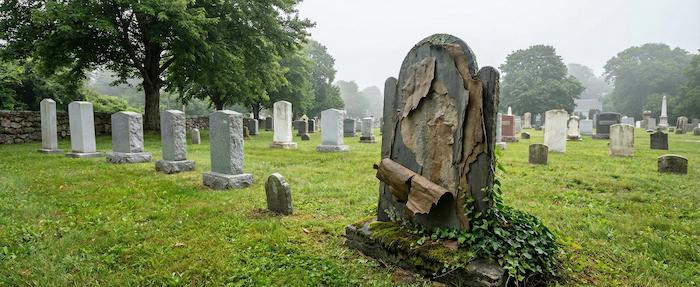
Woonsocket has two main problems: steep hills and old factory smoke. The mills shut down years ago, but the soot they belched out is still stuck to the monuments. In cemeteries like Precious Blood, you see headstones that look like black rock. They aren't. That is white marble covered in a thick layer of industrial exhaust.
The other issue is the terrain. This town is steep. Heavy rain washes the soil right out from under the monuments on the hillsides. Families searching for headstone cleaning services near me call us to gently remove that industrial black crust and to reset stones that are sliding down the slopes.
The "Black Crust" (Industrial Soot)
If you touch the black stones in Woonsocket, they feel rough, like sandpaper. That is a "gypsum crust." It happens when pollution reacts with the marble. It traps dirt and turns hard.
Scrubbing is a waste of time. It’s bonded to the surface. We have to cover it with a paste and let it sit. The chemical does the work, not us. After a few days, that hard shell turns into mush, and we just rinse it away.
"Sugaring" of Old Marble
You see a lot of French names at St. Jean Baptiste. The problem is they used soft marble that doesn't hold up well against acid rain. The binder inside the stone dissolves, and the surface gets grainy. It feels like loose sugar.
This is dangerous territory. If you take a pressure washer to this, you will destroy it. The water pressure will strip the names right off the face. The stone is so soft it just crumbles like wet sugar. We clean these strictly by hand, using soft brushes.
Hillside Erosion and Sliding Stones
Gravity is a problem here. On the steep plots, water runs down fast. It cuts channels around the base of the monuments. Eventually, the downhill side washes out, and the stone tips forward.
We can't just shove dirt back under it. The rain will take it again. We dig out the base and build a level pad using crushed stone and angular gravel. We lock the gravel in place so water drains through it instead of washing it away.
Lichens on Granite Bases
The Blackstone River keeps the valley damp. Lichen loves it here. It grows in heavy grey and green patches on the rough granite bases. It roots deep and holds moisture against the stone, which can crack it during a freeze.
We don't scrape lichen dry. It leaves scars on the stone. We soak it with a biological cleaner to kill the organism. Once it turns brittle and detaches from the rock, we brush it off gently.
Service Costs in Woonsocket
Removing a hundred years of soot is slow work. We have to be extremely careful with "sugaring" marble. Working on hillsides also adds labor—lugging gravel up a slope is hard work. We need to assess the site conditions before we give you a price.
- Soot Removal: Chemical stripping of industrial black crusts.
- Marble Conservation: Gentle cleaning for "sugaring" stones.
- Hillside Leveling: Rebuilding washed-out bases on slopes.
- Lichen Treatment: Deep cleaning for rough granite.


