
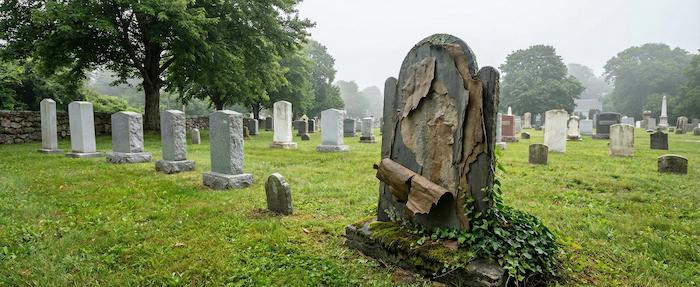
A granite headstone in an old Rhode Island family plot can tip sideways as bittersweet vines root directly under its base; a bronze veteran's plaque in Providence's old Jewelry District corrodes from a century of metalworking residue instead, with no vine anywhere nearby. Rhode Island packs 893 cemeteries into the smallest state in the country, and every one of them gets the same Tending headstone cleaning treatment, backed by a $2,000,000 liability policy and ICCFA membership. Which fix actually helps a Rhode Island headstone depends on what's really behind the damage.
How Rhode Island's Industry and Overgrowth Shape Headstone Care
Invasive vines root directly under monuments in older, less-tended family plots across the state. Blackstone Valley textile mill soot settled over Pawtucket-area cemeteries for more than a century, and Providence's old Jewelry District left bronze markers with a metalworking residue all its own.
Rhode Island Vine Overgrowth and Headstone Repair
Older, tucked-away family plots across Rhode Island face a steady threat from invasive vines, particularly Oriental bittersweet, which spreads aggressively through untended cemetery corners and climbs directly over monuments left unchecked for even a few seasons. A bittersweet vine seeking any gap around a monument's base roots wherever it touches soil, and the root system underneath keeps thickening year after year even if someone cuts the visible vine back at the surface. A root thick enough eventually pries a monument's base up and out of level, and a single vine can cover an entire family plot within just a few growing seasons. Poison ivy often grows alongside bittersweet in the same neglected corners, adding a safety hazard on top of the structural one, since anyone trying to clear the vines by hand risks a bad reaction without the right protection. A plot untouched for even two or three years can go from a single vine at the fence line to a wall of growth thick enough to hide an upright monument completely. Cutting the visible vine without removing the root only buys a season before new growth returns from the same crown. Tending digs out the entire root system around a monument's base and clears a buffer zone wide enough that new vines can't creep back and take hold again. Headstone repair follows once the base itself needs resetting, packing the excavation with gravel that gives the monument a stable footing the vines can't work their way back into.
Blackstone Valley Mill Soot and Headstone Lettering Repair
Pawtucket's Slater Mill, built on the Blackstone River in 1793, is generally recognized as America's first successful water-powered textile mill, and the Blackstone Valley grew into one of the most heavily industrialized textile corridors in the country over the following century. Coal-fired boilers powering the valley's mills released decades of soot into the air, and cemeteries throughout the Pawtucket and Woonsocket area absorbed a steady coating of it. The soot bonds to granite as a fine, dark film, and it settles directly into engraved letters along with the rest of the stone's surface. A name that was sharp and legible when it was first cut can read dim and gray within a couple of generations under a heavy enough coating. Cemeteries within a mile or two of the old mill buildings along the river tend to show the heaviest accumulation, since decades of soot settled thickest closest to the source. Household cleaners smear the residue sideways across the letter without actually lifting it free of the groove. An alkaline degreaser made to break down old carbon buildup dissolves the film chemically, and headstone lettering repair repaints whatever letter the soot had dulled once the surface is fully clean.
Providence Jewelry District Metalworking Residue and Bronze Marker Restoration
Providence earned the nickname Jewelry Capital of the World after Nehemiah Dodge developed an early gold-plating process there in the 1790s, and the city's Jewelry District went on to produce as much as 80 percent of the jewelry made in the United States at its peak. Decades of metalworking, electroplating, and finishing operations in and around the district released fine metallic particulate and plating-bath residue into the surrounding air. Bronze veterans' plaques in older Providence cemeteries downwind of the district absorbed some of that residue directly, and it bonds into a mottled, uneven film over the metal's original patina. The film sits on top of the original patina without reacting chemically with the copper underneath, dulling the surface unevenly and hiding the raised lettering. A specialized solvent lifts the metallic film without disturbing the patina underneath, and the crew regrinds the raised lettering back to bright bronze wherever the residue had buried it. Bronze marker restoration finishes with a fresh clear coat, giving the plaque a clean surface again after a century of someone else's industry settled onto it.