

Barre Granite and "Rock Pitch" edges
We live in the granite capital of the world. Most stones here are local Barre Gray. They are built to last, but those rough, "rock pitch" edges hold onto everything. Dust settles into that rough texture and turns the stone dark gray.
If you take a scrub brush to that rough rock, you just tear up the brush. You end up with plastic bristles stuck in the stone. Pressure washing is worse; it jams the dirt in deeper. We spray it with a cleaner that does the work for us. It loosens the grime so the next rain washes it clean. It brings back the sparkle without us having to scrub it.
Mud Season and Frost Heaves
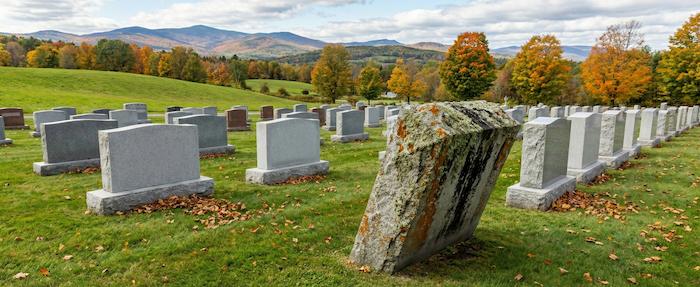
Mud Season is real. When the frost leaves the ground in April, the dirt turns into unstable mush. The ground movement is powerful. We see frost heaves lift heavy monuments and knock them completely off level.
We see stones tipping over or sinking halfway into the muck every spring. We provide professional grave site cleaning services that include leveling. We dig out the mud and put in a deep pad of crushed stone. The stone drains water away, so when the freeze comes back, the ground sits still and doesn't push the marker around.
Stubborn Mountain Lichen
The air up here in the Green Mountains is clean. That’s good for us, but it’s great for lichen. It grows thick and fast on granite, forming crusty circles that dig right into the polish.
If you try to scrape it off dry, you will scratch the polish. It holds on tight. We treat it with a cleaner that kills the plant down to the root. It turns a bright orange or yellow, then dries up and falls off. This gets the stone clean without us having to grind at it with a scraper.
Sugar Maple Sap
Our cemeteries are full of Sugar Maples. In the spring, the sap drips constantly. It lands on the headstones and hardens into black spots that stick like epoxy.
Once that sap cures, you can't get it off with a scraper; you’ll take a piece of the stone with it. We use a solvent that softens the sticky residue back into a liquid. Then we wipe it away. It’s slow work, but it’s the only way to get the spot off without ruining the shine.
River Silt from Flooding
Recent floods have hit our river valleys hard. A lot of cemeteries in the bottomlands were underwater. When the river went back down, it left a coat of fine silt on everything.
That silt dries hard, but it's gritty. Wiping it dry is a mistake; you'll scour the polish. We flood the stone with water to float the dirt off. We wash it down gently, so the grit doesn't get ground into the family name.
Historic Slate Delamination
Before granite took over, Vermonters used slate. You see these thin, dark stones in all the old town cemeteries. They are beautiful, but they split. Water gets in the top edge, freezes, and pops the layers apart.
You can't glue them back together with hardware store epoxy; it just seals water inside and rots the stone. We clean out the cracks and use a grout that binds the layers but lets the stone breathe. It stops the splitting so the face of the stone doesn't fall off next winter.