The "Road Tar" Layer
Rialto is full of trucks. Thousands of them. They dump diesel soot and tire rubber into the air all day. It lands on the cemetery. This isn't dust. It is sticky, oily exhaust.
The sun cooks it. It turns into a black tar. It seals the stone. Rain won't wash it off because it's grease. It doesn't clean a thing.
If you run your finger over the marker, it comes away black and greasy. If you are searching for headstone cleaning services near me because the stone looks dark, that is traffic sludge. You cannot scrub this off with soap. You just smear the oil around. Tending uses industrial grave site cleaning services with heavy-duty degreasers. We cut through this petroleum film chemically. We dissolve the rubbery residue to get down to the real stone without scratching the polish.
Cajon Pass Sandblasting
The wind screams down the Cajon Pass. It picks up silica grit from the wash. It hits Rialto hard. This acts like a commercial sandblaster running on high. It hits the windward side of upright monuments constantly.
It physically strips the mirror finish off granite. The stone goes dull. It looks "frosted" or matte gray. The reflection is gone because the surface is pitted.
You can't wash this damage away. The stone surface is missing. We treat this by cleaning the open pores to remove embedded grit. Then, we apply a specialized stone enhancer. It soaks into the micro-pits. It restores the deep color and creates a sacrificial barrier that takes the beating from the wind instead of the stone.
Thermal Shock and Loose Joints
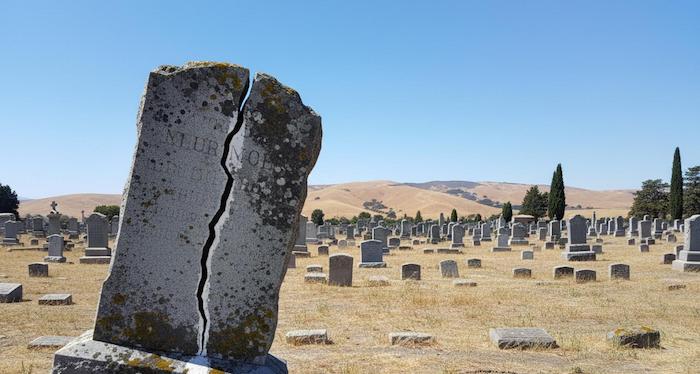
Rialto sits in a thermal trap. The summers are brutal. Dark granite gets hot. Burning hot. It bakes in the sun. It expands. When the sun sets or the wind kicks up, the stone cools rapidly and shrinks.
This cycle happens every day. The stone moves, but the rigid cement foundation does not. Snap. The adhesive seal breaks. The tablet starts to rock on its base.
A loose monument is a safety hazard. If you are looking for tombstone repair and restoration because a marker is wobbling, it is thermal stress. We clean out the old, failed mortar. We re-set the stone using flexible industrial epoxy. It acts like a shock absorber, stretching with the heat to keep the monument secure.
Irrigation "Concrete"
Sprinklers hit the hot stone. The water turns to steam. It leaves a heavy layer of calcium. It bakes on like white cement.
It looks like concrete splatter covering the name. You can't scrape it off; you will scratch the stone.
We use professional cleaning stone gravestones chemicals. We apply a descaler that melts the mineral bond safely. We turn the hard crust into a soft paste that rinses away, revealing the clean stone underneath.