
Removing Hard Water Scale and Fixing Frost Heave in Des Moines
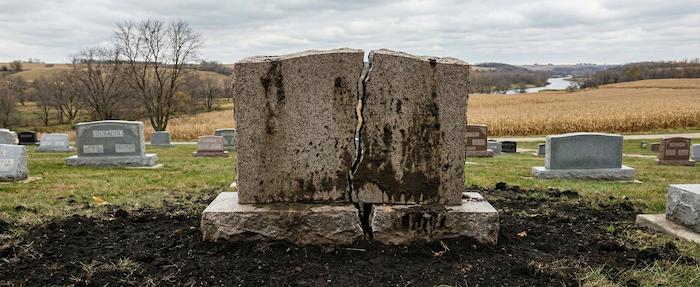
The soil in Des Moines is heavy, black loam. It holds water. When winter hits, that wet ground freezes deep and expands. It pushes up with massive force. It grabs the rough concrete foundations of the headstones. We see heavy granite monuments in Glendale Cemetery tipped over because the frost snapped the concrete pad right in half.
Summer brings a different headache. The cemeteries run sprinklers constantly to fight the heat. Des Moines water is full of minerals. Every time the sprinklers hit a stone, they leave a little calcium behind. Over a summer, this builds a hard, white line across the bottom of the polished granite. It looks like white paint, and it ruins the finish. Families searching for headstone cleaning services near me call us to level their heaved markers and to dissolve that stubborn white scale.
Fixing Frost-Heaved Foundations
Iowa soil moves. Heavy granite sinks in soft mud. When that mud freezes, it heaves the stone back up unevenly. Putting more dirt under a sinking marker is a waste of time. It just holds more water and freezes again next year.
We fix the foundation permanently. We lift the monument. We dig out the wet dirt and the broken concrete. We fill the hole with crushed, angular rock. We pack it solid. This gravel layer drains water instantly. If there is no water under the stone, the frost cannot push it up. The marker sits flat on the rock, no matter what the soil does.
Dissolving Irrigation Scale
The white haze on the bottom of the stone is calcium carbonate from the city water. It bonds to the granite. You can scrub it with soap all day, and it won't move.
We remove this chemically. We use a buffered acid designed to break the mineral bond. We brush it onto the white crust. It fizzes as it eats the calcium. We scrub the residue away and hose the stone down. The granite comes out dark and shiny again.
Killing River Valley Moss
Woodland Cemetery is old and full of trees. The humidity gets trapped under the canopy. This feeds moss and algae. We see thick green growth on the north side of the stones. It eats into the stone pores.
We kill it with a biocide. We saturate the moss. It turns to mush and releases its grip on the rock. We wash it off. This clears the stone immediately. We never scrape dry moss; the roots stay in the stone and it grows back in a month.
Cleaning Urban Soot
I-235 cuts right through the city. Traffic exhaust settles on the stones in the nearby cemeteries. It is an oily, black soot. It mixes with dust and creates a greasy film on the granite.
We cut this grease with a specialized cleaner. We spray it on and let it break down the oil. Then we scrub the stone with stiff brushes. The black sludge lifts out of the pores. We rinse it away, and the stone goes back to its original grey color.
Refinishing Green Bronze
Snow sits on the flat bronze markers in the memorial gardens for months. The water gets under the clear coat. The bronze turns green and chalky.
We strip the old finish. We sand the corrosion down to bare metal. We use a torch to heat the bronze. This ensures the metal is bone dry. We spray a new industrial clear coat on the hot metal. It bonds instantly. The plaque looks dark and legible again.
Repairing Mower Scuffs
Mowers run tight to the stones to trim the grass. They bump the granite. We see black rubber marks and chipped corners on the bases.
We clean the rubber marks with a solvent. For chips, we grind the sharp edge down with diamond files. We create a smooth bevel. It looks finished and prevents the mower from catching that spot again.
Service Costs in Des Moines
We don't need to visit the cemetery to give you a price. We have fixed, transparent pricing for all our services, including frost heave repair and hard water scale removal. Check our subscription builder to see the exact cost for your plot.
- Leveling: Fixing frost-heaved/sinking markers.
- Scale Removal: Dissolving hard water calcium.
- Moss Removal: Killing heavy biological growth.
- Bronze Care: Refinishing oxidized plaques.


