
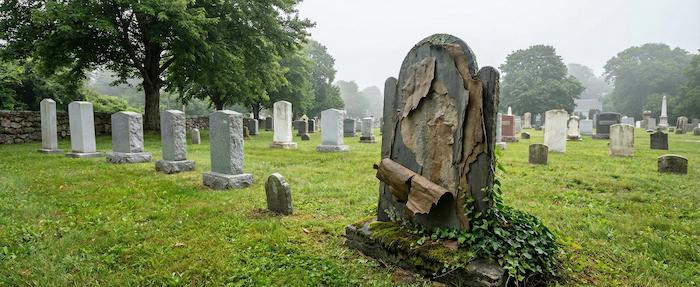
Preserving Historic Slate and Removing Sea Salt in Providence
Providence is old, and so are its cemeteries. Places like North Burial Ground and Swan Point hold centuries of history. But the location is tough on stone. We sit at the head of Narragansett Bay. The air is damp and salty. This salt eats into the granite and turns bronze green.
The other challenge is the material. Providence has thousands of colonial-era slate markers. These stones are fragile. They split and flake apart due to New England's freeze-thaw cycles. Families searching for headstone cleaning services near me call us to gently preserve these crumbling antiques and to wash away the sticky urban grime from I-95.
Slate "Delamination" (Peeling Stone)
Slate is made of thin sheets pressed together. Over time, water freezes inside and pushes these sheets apart. The stone starts to separate at the edges. A pressure washer is too aggressive for this. The force of the water will rip those loose layers right off the face.
We treat slate like an archeological find. We use soft natural bristle brushes and a biological cleaner. We don't scrub hard. We soak the stone to kill the lichen that holds the moisture in. Once the growth dies, the stone dries out and stops splitting.
Salt Air and Bronze Corrosion
The ocean air in Providence carries chlorides. Salt settles on bronze plaques and statues. It creates active corrosion—pale green, powdery spots that eat into the metal. This is different from a stable brown patina; this is rot.
We wash the bronze with a neutral soap to remove the salt residues. Then we heat the metal and apply a specialized hot wax. This wax seals the pores of the bronze and stops the salt air from touching the metal.
Urban Carbon Crust
Highway I-95 runs right past the major cemeteries. The exhaust fumes settle on the white marble and limestone. It builds up over the years into a thick, black shell. It feels rough and completely covers the original white stone.
Scraping doesn't work. The soot is cemented to the surface. If you chip at the dirt, you chip the stone. We apply a thick poultice to the stone and wrap it up tight. We leave it there for a couple of days. This gives the cleaner time to soften that hard black crust and pull the grime out from deep inside the stone.
Lichen on Rough Granite
The damp air coming off the bay creates the perfect environment for lichen. It grows aggressively here, digging its roots into the rough granite surface. These organisms produce acids that digest the stone minerals.
We saturate the stone with a biocide. We don't try to scrape every bit of lichen off immediately, as that damages the crystal structure. The chemical kills the root system. Over the next month, the dead lichen detaches and washes away with the rain.
Service Costs in Providence
Working on 18th-century slate requires patience and insurance. It isn't a quick wash-and-go job. Restoring bronze in a salt environment also takes extra steps for sealing. We need to assess the fragility of the monument before we give a price. We treat every stone as a unique preservation project.
- Historic Slate Care: Gentle biological cleaning for fragile markers.
- Bronze Preservation: Salt removal and hot wax sealing.
- Carbon Removal: Lifting industrial soot from marble.
- Lichen Treatment: Killing deep-rooted biological growth.


