
Stabilizing Loess Hill Monuments and Clearing Impacted Dust in Sioux City
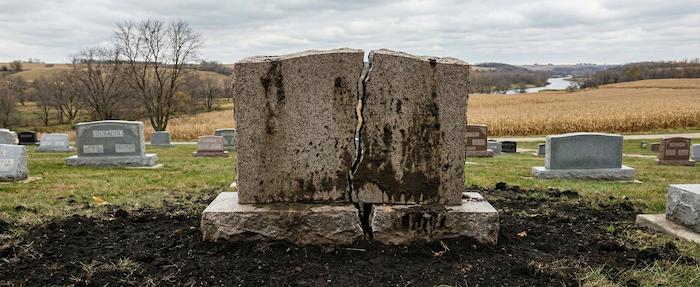
Sioux City sits on the Loess Hills. This soil is unique. It is fine, windblown silt packed tight. When it stays dry, it is solid. But when it gets saturated by heavy rain, it loses its strength. It collapses. We see this in the hillside cemeteries like Floyd and Calvary. Heavy monuments slide downhill or tip forward because the ground underneath them simply dissolved into mud.
The wind is the other factor. It blows constantly off the plains. It carries that fine loess dust. It hits the headstones and packs into the deep engraving. It is finer than sand. It creates a hard plug inside the letters. Rain turns it into a concrete-like paste. You can look at a stone in Logan Park and not be able to read the name because the inscription is filled flush with the surface. Families searching for headstone cleaning services near me call us to stabilize their sliding monuments and to pick that hardened silt out of the family names.
Fixing Foundations on Loess Soil
Building on loess is tricky. If water gets under the foundation, the soil fails. Adding more dirt under a leaning stone doesn't work; it just washes out.
We fix this with drainage. We lift the monument. We dig out the silt and the failed concrete. We install a deep pad of crushed, angular gravel. We pack it solid. Gravel drains water instantly. It keeps the loess soil underneath dry and stable. This creates a shelf that holds the heavy stone, even on the steep hillsides of the North Side.
Clearing Impacted Loess Dust
Pressure washing fails on this dust. It is too fine. It packs tighter when you hit it with water pressure. If you blast it, you risk chipping the stone.
We clean this by hand. We use a surfactant to soften the mud plug. Then we use wooden picks to scrape the silt out of every single letter. We flush it clean. We clear each character individually. It is slow work, but it restores the contrast. The inscription pops out against the polished granite again.
Killing River Valley Mold
The Missouri River keeps the air damp. Black mold and green algae love this humidity. We see stones in Graceland Park that are completely black. This biological growth eats into the stone pores.
We kill it chemically. We apply a biocide that soaks into the growth. It kills the roots deep in the stone. The black stain turns brown and washes away. This cleans the stone without scrubbing, which protects the polish.
Restoring Oxidized Bronze
Winter snow piles up on the flat bronze markers in Memorial Park. The moisture penetrates the protective lacquer. The bronze turns green and chalky. The lettering becomes hard to read.
We refinish them on-site. We strip the green corrosion down to bright metal. We heat the bronze with a torch to dry it out completely. We spray a new industrial clear coat on the hot metal. It bonds tight. The plaque looks dark and readable again.
Repairing Mower Scuffs
Mowers run tight to the stones to trim the grass. They bump the granite. We see black rubber marks and chipped corners on the bases.
We clean the rubber marks with a solvent. For chips, we use diamond files. We grind the sharp, broken edge into a smooth bevel. It looks finished and prevents the mower from catching that same jagged spot again.
Service Costs in Sioux City
We don't need to visit the cemetery to give you a price. We have fixed, transparent pricing for all our services, including hillside leveling and detail cleaning. Check our subscription builder to see the exact cost for your plot.
- Leveling: Stabilizing monuments on Loess soil.
- Detail Cleaning: Hand-picking impacted dust.
- Mold Removal: Killing heavy biological growth.
- Bronze Care: Refinishing oxidized plaques.


