
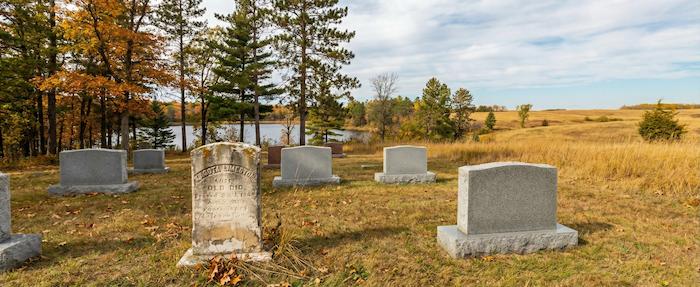
Stone Care on the Hillside
Duluth is built on a steep rock face dropping into Lake Superior. Gravity is the enemy here. In cemeteries like Forest Hill and Calvary, the ground is always trying to move downhill.
We fight the slope erosion that undermines foundations, and the heavy lichen growth caused by the damp lake air. We also clean off the industrial soot from a century of shipping iron ore. Families searching for headstone cleaning services near me call us to secure markers on the steep grades and strip away the black crust that the port industry left behind.
Slope Erosion and Sliding
Most Duluth cemeteries are terraced on the hill. Rainwater runs down these slopes fast. It cuts channels around the base of the headstones.
The water washes the soil out from the downhill side. The stone tips forward and eventually slides. We can't just push it back up. We have to rebuild the footing. We dig a level bench into the slope and install a retaining barrier of crushed rock. This stops the water from undercutting the monument again.
Lake Fog Lichen
Lake Superior pushes cold, damp fog up the hill. This moisture clings to the stone surfaces.
This environment breeds thick, crusty lichen. It covers the granite in grey and green patches. These aren't just surface stains; they eat into the polish. We don't scrape them. We apply a biological cleaner that kills the organism. The lichen releases its grip and washes off, leaving the stone undamaged.
Industrial Port Soot
For years, the air here was thick with coal dust and taconite. It settled on the older monuments in Oneota and Forest Hill.
It formed a hard black shell. It looks like dirt, but it is stubborn grease and iron dust baked onto the rock. We use a chemical poultice to melt that crust. We wash the sludge away to show the real stone underneath.
Duluth Gabbro "Rust"
Many local stones are made of Duluth Gabbro. Locals call it "Black Granite," but it is actually a different type of rock. It contains high amounts of iron.
When exposed to the wet lake air, the iron inside the stone rusts. You see cloudy orange patches on the black surface. We treat this with a chemical reducing agent. It turns the rust back into a liquid that we can rinse away, restoring the dark color.
Frost Heave on the Ridge
The frost goes deep here—sometimes five feet down. When that much ground freezes, it lifts with massive force.
If the footing is shallow, the frost heaves it out of level. We see stones tipped over every spring. We have to dig out the frozen soil. We replace it with deep drainage gravel. Dry rocks don't freeze. That stops the heaving.
Sandblasting from the Lake
The wind coming off Lake Superior carries sharp grit. Over eighty years, it wears the stone face down.
It dulls the polish on the windward side of the stones. The lettering loses its sharp edge. We can't repolish the stone in the cemetery, but we can apply a stone sealer. This brings back some of the contrast and stops the wind from wearing the stone down further.
Service Costs in Duluth
Working on the steep hillside is difficult. We often have to carry gear by hand because trucks can't reach the slope. Cleaning industrial soot is also labor-intensive. We inspect the site access and stone condition before giving a quote.
- Hillside Stabilization: leveling stones on steep slopes.
- Industrial Cleaning: Removing coal and iron ore soot.
- Lichen Removal: Cleaning biological growth from lake dampness.
- Rust Treatment: Restoring Duluth Gabbro markers.


