
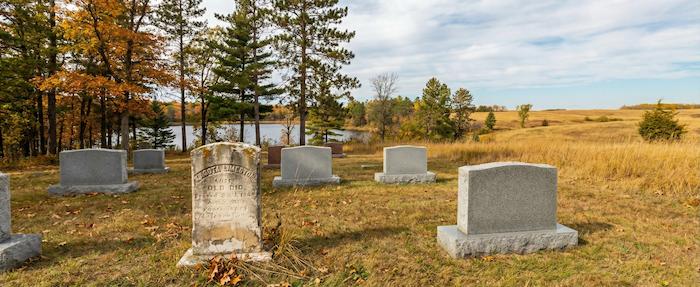
Loose Anoka Sand Plain Settles Flat Markers
The Anoka Sand Plain runs beneath most of Brooklyn Park, and that loose, fast-draining sand does not hold a granite monument the way heavier clay soil does. Flat markers settle into it within a few seasons, and heavy lawn irrigation across the suburb leaves a chalky mineral crust on polished stone. Our crew handles both problems for families searching for headstone cleaning services near me throughout the northern Twin Cities suburbs. Tending carries a $2,000,000 liability policy and is a member of ICCFA, the industry's leading cemetery and funeral association.
The sand under Brooklyn Park drains almost as fast as gravel. It carries almost no clay to bind it together, so it compacts unevenly under the weight of a granite marker. Ants make the problem worse: colonies tunnel under upright foundations and carry grains out a few at a time until the footing loses its support and the stone leans.
Our crew locates a sunken flat marker with a probe, cuts back the turf, and lifts the stone level again. We pack angular crushed rock underneath the stone to hold it in place. Ants cannot tunnel through packed rock, and it will not settle the way loose sand does. The same approach stabilizes a tipping foundation: we reset the monument and rebuild the footing with material that holds its shape. This structural work falls under Tending's headstone repair and restoration service.
Winter brings a related problem. Road salt drifts off nearby highways and works into the stone surface, and the same loose sand that swallows flat markers lets ants tunnel under upright foundations until they tip further. Tending's technicians trace each problem to its source in the soil or water, then fix the actual mechanism causing it, whether that means a settling foundation, mineral scale, or salt damage. Most calls for headstone restoration and monument restoration services in Brooklyn Park lead back to the sand plain itself.
Hard Water Scale from Suburban Irrigation
Brooklyn Park runs heavy lawn irrigation to keep suburban grass green through the summer. The water carries dissolved iron and calcium, and the sun bakes it onto hot granite within minutes of each cycle. What is left behind is a hard white scale or a rust-colored line across the base of the stone, and it bonds to the polish almost like cement.
Soap and water will not touch this kind of buildup. Our technicians use a chelating solution that lifts the mineral deposits without etching the granite underneath, then rinse the stone and restore its original polish. Regular sprinkler cycles bring the scale back within a few years, so a standing care plan keeps it from building up again.

Road Salt Drift Along Highway 169 and Highway 610
Highway 169 and Highway 610 both run through Brooklyn Park, and winter plows spray salt brine onto everything nearby, including roadside cemeteries. The salt works into the stone's pores and stays there through spring thaw. Over a few winters it pits the granite surface and dulls the polish from the inside.
"Customer service is top notch and the finished work product is excellent. My grandparents headstone is looking like new. Definitely recommend their service"
— Joyce, Tending Client
We treat this with a chelating rinse that draws the dissolved salt back out of the stone's pores before it spreads further. This will not undo pitting that has already formed, but it stops the deterioration from continuing. The same crew handles bronze markers along these routes with our bronze marker restoration service, and fading inscriptions nearby often need headstone lettering repair as well.
Service Costs in Brooklyn Park
Tending prices every job through an online calculator based on monument type and the care plan you choose. There is no in-person visit before payment; you enter details about the marker and get a fixed price before scheduling. For accurate pricing on sunken marker repair, scale removal, or salt treatment, start with our online calculator.
- Marker Raising: Lifting and leveling flat markers that have settled into loose sand.
- Scale Removal: Clearing hard water and mineral deposits left by lawn irrigation.
- Salt Treatment: Drawing road salt out of granite pores before pitting spreads.