
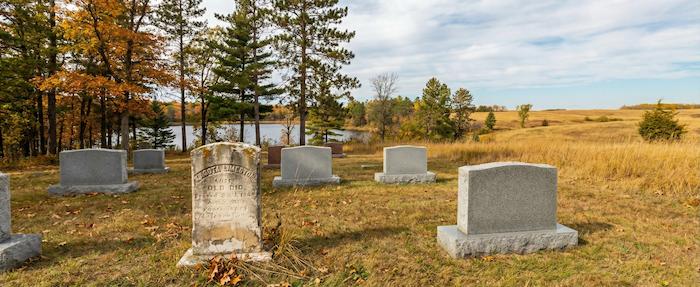
The open-pit mines of Minnesota's Iron Range and the limestone bluffs above the Minnesota River near Mankato sit nearly two hundred miles apart, and a headstone set in one place shares almost nothing with a headstone set in the other. Tending brings the same $2,000,000 liability policy and ICCFA membership to headstone cleaning and restoration jobs across all 3,686 of Minnesota's cemeteries. A problem common on one side of the state is often something a cemetery two hundred miles away never sees at all.
How Minnesota's Climate and Terrain Shape Headstone Care
Minnesota's deep frost line works underground on a monument's foundation. Winter road salt attacks bronze and granite alike near well-traveled roads, and Kasota limestone from the state's own historic quarries erodes at its own steady pace.
Minnesota's Deep Frost Line and Headstone Repair
Minnesota winters push frost deep into the ground, sometimes more than four feet down by the end of a hard season, and deeper still across the northern third of the state. Water trapped in the soil turns to ice, and freezing water expands. The ice pushes against anything nearby, including a headstone base with a shallow footing. Every winter the frozen ground shoves against the base from below, and every spring the thaw lets go all at once. A base that moves a fraction of an inch each winter adds up over twenty or thirty years into a monument leaning several inches out of plumb. Cemeteries set in sandy outwash see the fastest movement, since sand releases meltwater almost as soon as the ground thaws. A shallow reset doesn't hold here. Tending digs down past the active frost zone and builds a new footing on ground that stays put through the winter. Crushed rock packed around the base lets water drain straight through, so nothing collects there to freeze. That work falls under headstone repair and restoration, and a footing set below frost depth generally outlasts the family that requested it. Tending checks the footing again after the first hard winter, since that's when any new movement usually shows up first.
Winter Road Salt and Bronze Marker Restoration
Minnesota's road crews spread hundreds of thousands of tons of salt across state highways every winter, and cemeteries built along or near those roads catch a share of it. Plows throw salt spray well past the shoulder, and the wind carries fine salt dust even farther once the roads dry out. Bronze veterans' markers near well-traveled roads pick up that salt season after season. The metal starts out with a normal brown patina, and within a decade or two along a heavily salted route, it turns dark and blotchy. Granite nearby reacts too, developing a hazy white film that dulls the polish without cutting into the stone underneath. Once corrosion sets into bronze this deep, a rinse only moves the salt around. Tending's crew treats the metal chemically to lift the buildup, works the surface back toward its original color by hand, then finishes with a fresh coat of clear sealant. That process is bronze marker restoration, and a marker near a well-salted road usually needs it again within five or six years.
Kasota Limestone Erosion and Headstone Lettering Repair
Quarries around Mankato and the town of Kasota have supplied southern Minnesota with a warm, buff-colored dolomitic limestone for more than a century, and a large share of the region's older headstones came from those same quarries. The stone carves easily and holds fine lettering well, and its dolomite content makes the bulk stone genuinely weather-resistant, which is exactly why architects favored it for landmark buildings across the state. Fine engraved lettering doesn't get that same durability, since a carved letter is only ever a fraction of an inch deep to begin with, and even the slow surface loss a resistant stone like this sees over a century is often enough to blur a name that was once sharp. Acidic rainfall and freeze-thaw cycling do most of that gradual work, and carved lettering sits at the exact depth where the loss shows first. A name cut a hundred years ago into Kasota limestone is often shallow and faint today, sometimes barely visible against the stone's warm color in low light. Recutting the lettering only holds if the stone underneath stops losing material first. Tending treats the surface to slow the erosion, then recuts and fills each letter to a depth that matches the monument's original carving. That work is done under Minnesota's headstone lettering repair standards, and a stone treated this way keeps a readable inscription for years to come.