
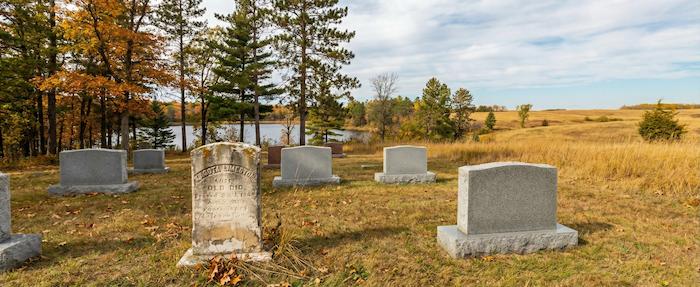
Historic Lime Quarrying Left Grey Cloud Island Ground Uneven
Grey Cloud Island, part of Cottage Grove along the Mississippi River, was home to a working lime kiln dating back to around 1850, one of the pioneer industrial operations that helped build the state and still standing today as a listed historic site. Producing lime meant quarrying the island's limestone bedrock in the immediate area, and the ground around those old quarrying and kiln operations was never engineered the way a modern foundation site would be once the operation wound down. Workers cut directly into exposed limestone ledges and backfilled the resulting pits with loose quarry spoil and kiln waste, skipping the compacted engineered fill a modern crew would use, and leaving pockets of loosely packed material scattered across the island's low ground.
A headstone base set into this kind of disturbed, partially excavated ground settles differently than a marker on undisturbed island soil nearby, sometimes shifting gradually over many decades as old quarry-adjacent fill continues to compact under its own weight and seasonal moisture. The exact boundaries of the historic operation were never carefully mapped for future reference, which is part of why the settling can look inexplicable at first glance, and why two graves set only a few yards apart can settle at noticeably different rates. Families who reach out about headstone cleaning services near me on Grey Cloud Island are frequently dealing with something more structural than surface grime — a stone that has visibly dropped, tilted, or pulled away from its footing for no obvious reason. Tending checks the ground's quarrying history before resetting an affected base, since old kiln-era disturbed soil needs a different footing approach than solid, undisturbed bedrock, often calling for a wider, deeper footing pad that spreads weight evenly across the loose fill. Larger structural repairs are covered under headstone repair and restoration.
Glauconitic Sandstone Groundwater Leaves a Greenish Tint
Bedrock in the southern part of Washington County includes the Franconia Formation, a fine-grained sandstone rich in glauconite, a greenish mineral that gives this rock its distinctive color. Groundwater passing through glauconite-bearing sandstone picks up trace iron and potassium from the mineral itself, and that groundwater can leave a faint greenish tint on nearby stone as it evaporates, different from the plain white mineral crust more common limestone groundwater produces elsewhere. The Franconia sits within the broader aquifer system much of the metro area draws on, and shallow groundwater moving laterally through the glauconitic layers before reaching a headstone's base carries that mineral signature with it regardless of how far the stone sits from open water. The tint tends to be subtle at first, building up gradually enough that it can take years before anyone notices the color shift.
Bronze veterans' plaques exposed to the same glauconitic groundwater can pick up a similar tinted discoloration layered on top of the metal's usual patina. When a plaque near an affected headstone needs attention, Tending typically covers bronze marker restoration in the same visit as the mineral-specific stone treatment, since both problems trace back to the same groundwater chemistry. Most stones only need this particular treatment every several years. A routine cleaning alone doesn't need to include it.

Winter Cold Cycles Through Older Stone Unevenly
A monument doesn't cool and warm as one solid piece — the surface responds to outside temperature well before the stone's interior catches up, and that lag creates real internal stress every time a Minnesota cold snap moves through. Washington County typically cycles through several dozen freeze-thaw swings each winter as daytime highs climb back above freezing before overnight lows drop well below it again, and each swing repeats that same surface-versus-core stress on every exposed monument. Marble and limestone absorb more moisture into their pore structure than dense granite does, so when that trapped water freezes and expands, it works loose the crystalline bonds holding the surface together well before granite shows comparable wear. Over enough winters, that repeated internal pulling apart works into whatever weaknesses the stone already had, softening engraved lettering years before a family might otherwise expect it. Marble and limestone markers show this wear well ahead of granite pieces from the same era, since granite's tighter grain resists the internal stress far better. A name carved a century ago on marble can already be difficult to read while a granite neighbor from the same decade still looks sharp.
Tending recuts and repaints lettering worn down by this pattern, following headstone lettering repair standards suited to the older marble and limestone monuments common on Cottage Grove's historic plots.
Service Costs in Cottage Grove
Tending's online calculator returns a fixed price as soon as the monument type and care plan are entered, and no technician needs to visit the plot in advance just to size up the damage. Because disturbed quarry ground, glauconitic groundwater, and winter freeze cycling all develop slowly and tend to recur across seasons, an ongoing maintenance plan can be layered onto any of the three at checkout.
"I am so glad I discovered the Tending service. My parent’s headstone needed a deep cleaning to remove dirt, algae, dark areas. The area around the head stone also needed tending to remove leaves, weeds. After signing up I was quickly contacted by a project manager who kept in constant touch, provided all the info the cemetery required, and set a date for the work to be completed. I was sent detailed photos after the work was completed and the change was amazing- the headstone looked like it did when first installed. All the lettering was so clear and before the work much of it was unreadable. I would highly recommend Tending."
— JB, Tending Client
- Base resetting and stabilization: correcting settlement over historic quarry ground.
- Glauconite stain and bronze treatment: mineral-specific cleaning for stone and metal.
- lettering repair: recutting engraving worn by uneven winter freeze cycles.