
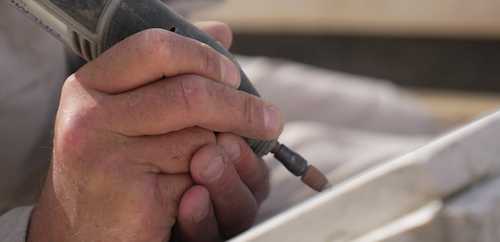
Granite quarried around St. Cloud, "Granite City" since the 1860s, and the roughly 3.5-billion-year-old Morton gneiss cut near Renville County both ended up on monuments across Minnesota, and their dense, low-porosity structure gives carved lettering almost nothing to soak into, so a repaint's hold comes down entirely to the mechanical grip of the carved channel itself. Freeze-thaw cycling works at that bond everywhere in the state, open prairie country in the west fades finishes under sun with little tree cover to interrupt it, and dying ash trees killed by an invasive beetle are changing how much shade and moisture older monuments get across the state's historic burying grounds. Every lettering job in Minnesota runs under Tending's $2,000,000 liability policy and ICCFA membership.
Minnesota Granite and Mechanical Bonding
St. Cloud has been known as Granite City since commercial quarrying began there in the 1860s, and stone cut from the area has gone into work ranging from the Stearns County Courthouse to national memorials in Washington, D.C. Farther southwest, Morton gneiss quarried near Renville County dates back roughly 3.5 billion years, among the oldest exposed bedrock anywhere on earth, and its swirled banding makes it a distinctive, popular monument stone. Both are dense, low-porosity granites, so paint on a letter carved into either one has almost no surface texture to grab onto; the channel's own shape, not the stone's porosity, is what keeps a repaint locked in place. Once that grip fails, a small amount of moisture or debris trapped in the groove can work a whole section loose.
Freeze-Thaw Expansion Statewide
The Twin Cities area alone averages somewhere between 55 and 60 separate freeze-thaw cycle days most winters, with some seasons running well past 90, and moisture sitting in a carved letter grows by roughly a tenth of its volume the moment it turns to ice. That swelling puts most of its force into paint that has already started to loosen, doing far less damage to a section still gripping the channel tightly, so an older repaint tends to absorb the worst of the seasonal wear. Deep cold in the north settles in and mostly stays put for weeks at a stretch, producing comparatively few of these freeze-refreeze events each winter; farther south, the ground temperature crosses back over the freezing mark dozens of separate times before spring finally holds.
Open Sun Across the Prairie
Western and southwestern Minnesota's prairie pothole country, shaped by retreating glaciers roughly 10,000 to 14,000 years ago, offers little of the tree cover found in the state's more wooded regions, and cemeteries out on that open ground take direct sun for most of the day with nothing nearby to interrupt it. That kind of sustained UV exposure fades painted lettering on its own, without freeze-thaw or debris involved at all. Letters faded this way generally keep their shape and adhesion; the pigment is what fails first, fading down to a faint outline that's still readable up close.
Emerald Ash Borer and Changing Canopy
The emerald ash borer was first found in Minnesota in St. Paul in 2009, and an infested community typically loses most of its untreated ash trees within 10 to 15 years of the beetle's arrival. Many of the state's older, historic burying grounds were planted with ash decades before the infestation reached them, and a canopy that thins out or disappears entirely changes how much shade and moisture the monuments underneath receive, sometimes putting lettering that spent decades in deep shade under direct sun and much wider temperature swings for the first time. A dead ash coming down can also strike a monument outright, a sudden risk distinct from the gradual fading canopy loss otherwise causes.
Headstone Lettering Repair Costs in Minnesota
The calculator works from character count and carving depth read straight from a family's submitted photos and returns a fixed price with no cemetery visit required. Which of these four causes actually did the damage doesn't change that number. Once the repainting is finished, photos of the completed letters get posted through the Tending app for the family to check on their own time.
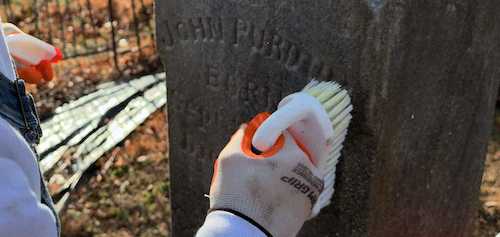
How Our Headstone Lettering Repair Process Works
- Narrowing Down the Cause From Photos Photos pointing to a loosened mechanical bond, freeze-thaw lifting, prairie sun fade, or new canopy exposure each look distinct enough to steer a technician toward a likely cause ahead of the visit.
- Clearing Out What's Left of the Old Paint A hand tool removes failed paint from the channel letter by letter, along with any grit or debris packed inside, while sound paint stays in place.
- Flushing the Groove to Bare Stone A rinse suited to what's actually in the channel, mineral grit, organic debris, or plain dust, clears it down to material solid enough to hold new enamel.
- Making Sure the Channel Is Fully Dry Compressed air drives out any remaining moisture, since paint sealed over a groove that's still even slightly damp is a common reason a repaint fails within months.
- Packing In New Enamel and Wrapping Up Thin layers of enamel go into the clean, dry groove one at a time until the letter sits back at its original depth. Once it's cured, photos of the finished carving go up through Tending's app for the family to see.
