
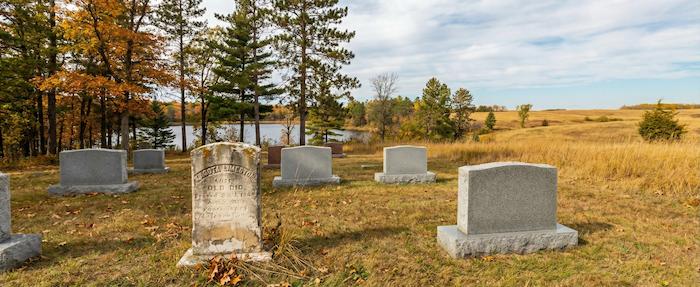
Karst Sinkholes Undermine Monuments Beneath Olmsted County
Rochester's cemetery ground moves in ways most Minnesota towns never see. Underneath cemeteries like Oakwood and Calvary, the bedrock is dissolved limestone, full of old cavities that geologists call karst. When a pocket collapses under a footing, a monument can drop several inches overnight instead of tipping slowly the way frost heave does. Families searching for headstone cleaning services near me in Rochester are often dealing with a stone that has shifted underground, not just surface grime. Tending carries a $2,000,000 liability policy and is a member of ICCFA, the industry's leading cemetery and funeral association.
"Dachi and team were kind enough to get our son’s headstone cleaned in time for his birthday. Really great people to work with and highly recommend."
— SK, Tending Client

Groundwater has been eating through the limestone for thousands of years, and those cavities don't always stay hidden below the surface. Tending's technicians have pulled headstones out of holes a foot deep after a single wet spring. The fix means excavating down to solid ground, packing the void with angular rock that won't wash away, then compacting a gravel base on top before the stone goes back. That kind of headstone repair and restoration needs to happen before any cleaning starts. A stone reset on loose fill just sinks again within a season.
Zumbro River Silt at Oakwood Cemetery
Oakwood Cemetery sits close enough to the Zumbro River that spring flooding and heavy runoff reach the lower rows. The water carries fine silt, and once it dries on the stone, the carving turns rough and cement-hard, filling every letter of the inscription.
Scrubbing it dry acts like sandpaper on polished granite. We soak the silt back into mud first, then flush it out of the carving with low-pressure water and a soft tampico brush. The process takes longer than a quick wipe-down, but the lettering survives clean and legible.
Rochester's hard water adds another layer of work here too. Sprinkler overspray and years of mineral-heavy rain leave a rough orange crust across grey granite, and once it bakes onto the surface, an ordinary gravestone cleaner near me search won't turn up anyone equipped to remove it safely. A quick headstone repair near me search turns up the same kind of problem, general listings with no cemetery-specific experience handling either stain. The same visit that flushes silt out of the carving also lifts that mineral crust, so both problems get handled without a second trip.
Delamination in Rochester's Historic Quarry Stone
The earliest markers in Rochester's older cemeteries came from local limestone quarries, cut in layers the way sedimentary rock naturally forms. That layering makes the stone easy to carve, but it also gives water a seam to work into, and older sections of Calvary and the State Hospital Cemetery show the pattern clearly once you know what to look for.
Once moisture gets between the layers and freezes, the face of the stone splits away in a thin sheet. That piece cannot be reattached. Our technicians seal the open seams with a stable injected grout, keeping water out before the next freeze can pry off another layer. A quarry-stone marker treated early keeps its carved face for decades longer.
Service Costs in Rochester
Every project in Rochester gets priced through Tending's online calculator. Customers pick the monument type and a care plan, and the calculator returns a fixed price immediately, with no site visit required before payment. That price covers everything from ground stabilization to quarry stone repair, and it holds whether the stone sits in a downtown cemetery or a rural township plot. Check our online calculator to see exact costs before you book monument restoration services in Rochester. Bronze markers and nameplates need a different chemistry than granite, and Tending handles that through a separate bronze marker restoration service. Lettering that has faded past readability gets restored separately too, through headstone lettering repair.
- Ground Stabilization: resetting monuments that have dropped into karst voids or settled unevenly.
- Silt and Mineral Removal: clearing Zumbro River silt and hard-water buildup from carved surfaces.
- Quarry Stone Repair: grouting and stabilizing delaminating historic limestone markers.