
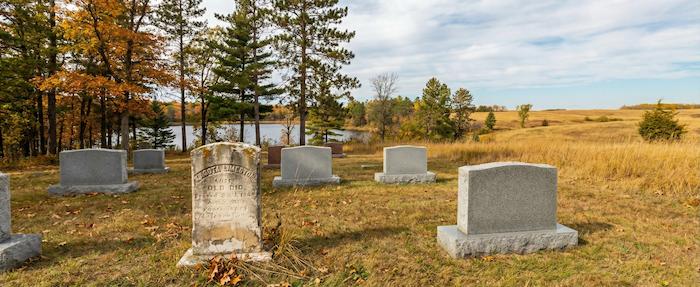
Shrink-Swell Clay Tips Headstones Across Washington County
The glacial till under Woodbury carries a lot of clay, and this clay changes size with the weather. A wet spring swells it against the concrete footing under a monument. A dry August pulls it back, leaving a gap the footing can rock inside. Families searching for headstone cleaning services near me in Woodbury often find a marker that has started to lean for exactly this reason, or one that has simply gone dull under mineral buildup. Tending's crew works cemeteries across Washington County, cleaning and resetting granite and marble without power tools or harsh acids. Tending carries a $2,000,000 liability policy and is a member of ICCFA, the industry's leading cemetery and funeral association.
That gap is what tips a headstone. Years of clay swelling and shrinking do more damage than any single storm, and water that collects in the gap freezes in winter and pushes the stone further off level. Tending's headstone repair and restoration crew digs out the loose clay around the base and replaces it with crushed rock. Crushed rock locks together and doesn't shift size the way clay does. That gives the monument stable footing again.
At Saint John's Lutheran Cemetery and the other older sections around the city, the same clay movement affects headstones every year. Two more problems show up just as often on service calls here: sand pockets that ants hollow out, and drainage that changed once new subdivisions went in around the old plots.
Ants in the Sand Veins
Not all of Woodbury's ground is clay. Veins of sand run through the till in patches, left over from the same glacial deposits, and ants find them fast. In the older, more rural sections of the city's cemeteries, colonies tunnel straight under a headstone's footing looking for loose material to move.
"Judging from the photos received, it looks much better. I plan to go to the cemetery in the next few days. I anticipate the actual work accomplished will be as good as, if not better than the photos. Mom"
— Dee Roach Perazzo, Tending Client

Every grain of sand they carry out becomes an empty pocket underground. The corner of the stone above it eventually drops into that pocket. A headstone that looks like it's sinking on one side is often just following an ant tunnel down. We clear the nest and pack the void with compacted gravel. Ants can't move gravel, so colonies don't come back.
The "Bowl Effect": Drainage From New Subdivisions
Woodbury has grown fast, and every new development raises the ground around it a little. Streets get built up and yards get graded higher, and cemeteries that used to sit level with their surroundings now sit in a shallow bowl below the new grade.
Runoff from those newer streets and yards drains toward the low point, and the low point is often the cemetery. The ground stays soggy longer after every rain, and soft, saturated soil doesn't hold a monument's base the way firm ground does. Stones settle and sink into it. We lift the affected markers and build a raised gravel pad underneath before resetting them. That keeps the base above the standing water.
Some of Woodbury's older family plots also carry bronze veteran markers. Bronze pits and streaks differently than granite does in this same wet clay, and our technicians handle bronze marker restoration as a separate process from stone cleaning. When irrigation deposits or years of clay movement blur carved dates and names past reading, headstone lettering repair recuts the lettering without changing the stone's original design.
Service Costs in Woodbury
Pricing for monument restoration services is set before any work happens, through our online calculator. Pick the monument type and the care plan, and the price is fixed from there -- it doesn't change once a crew is on site working around Woodbury's clay.
- Clay Foundation Reset: Removing shifting clay from around the base and replacing it with crushed rock.
- Sand Void Repair: Clearing ant tunnels and packing compacted gravel into the hollow space beneath a settled stone.
- Drainage Correction: Raising a sunken marker onto a gravel pad above the new water line.