
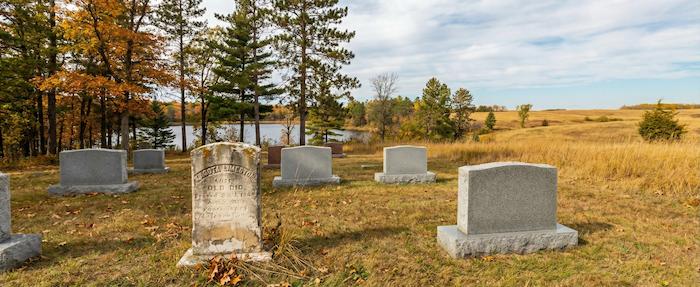
Decades of Utility Trenching Leave Ground Unevenly Settled
St. Louis Park is one of the more densely built inner-ring suburbs in the Twin Cities, and that density came with decades of water, sewer, and gas line work cut through the same streets and lots over and over as the city grew. Every trench dug for that infrastructure eventually gets backfilled, and the soil packed back in rarely compacts at the same rate as the undisturbed ground around it. Older neighborhoods near the city's original utility corridors carry more of this patchwork fill than newer sections built with modern compaction standards, and the difference can show up decades later in ways that have nothing to do with the age of the monument itself.
A headstone base set into one of these old trenched-and-refilled areas can settle at its own pace, sometimes years after nearby markers on undisturbed ground have long since stopped moving. Old utility maps from decades past rarely lined up with what actually got dug and backfilled at the time, so pinning down the exact cause today usually comes down to examining the ground itself. Paperwork rarely tells the full story. That kind of tilt is often what turns into a headstone cleaning services near me search for St. Louis Park families — the stone shifted first, and only later does anyone trace it back to a decades-old utility line running underneath. Tending checks the ground history around an affected plot before resetting the base, since a standard footing over still-settling trench fill won't hold for long. Larger structural repairs are covered under headstone repair and restoration.

Mature Urban Tree Canopy Deepens Shade and Algae
St. Louis Park's older residential blocks carry decades of established elm, maple, and oak plantings, and the tree canopy over many of the city's oldest cemetery sections has grown considerably denser since those trees first went in. Older sections stay noticeably wetter for longer stretches after a storm than newer, more open plots nearby, and algae takes hold wherever that dampness lingers. A marker planted the same decade as a nearby tree can end up shaded far more heavily now than anyone would have expected when both first went into the ground.
"The peace and the amazing work that this company is bringing to our family is beyond anything I could put into words. My grandparents are buried so far away from where I am now and without this company, the guilt of not being able to get to my grandparents grave would haunt me continually. I am truly grateful to have found this company. Their work and respect they provide to us is immeasurable. Absolute gratitude"
— for Cannon Flowers, Tending Client
Bronze veterans' plaques under the same canopy pick up a heavier green corrosion for the same reason, since the persistent moisture speeds up the metal's natural patina. That heavier corrosion is what Tending's crew addresses with a treatment calibrated for shaded urban plots, folding bronze marker cleaning and restoration into the same visit for plaques affected by the same tree cover.
Twin Cities Winters Take a Toll on Softer Stone
St. Louis Park sits well within the same severe winter belt that covers the rest of the Twin Cities, and older monuments here go through the same brutal cycle every year: deep cold locks moisture in place for weeks, then a spring thaw lets it move again, and the expansion and contraction in between slowly works apart whatever weaknesses already existed in the stone. Marble and limestone give way to this cycle faster than granite does, since their internal structure holds onto water in a way granite's tighter crystal matrix resists.
Once that cycle has worn into a piece of engraved lettering, the depth of the carving flattens out year over year until reading a name from a few feet away gets genuinely difficult. Tending addresses this by recutting the lettering back to something close to its original depth and repainting it, drawing on headstone lettering repair methods developed specifically for markers that spend six months of the year under Minnesota snow.
Service Costs in St. Louis Park
A fixed price comes from Tending's online calculator after the monument type and care plan are chosen — the damage gets assessed from the details entered, no scheduled site visit involved. Markers dealing with old trench fill, heavy shade, or winter freeze-thaw wear can add a maintenance plan, since each of those problems builds slowly and tends to resurface across multiple seasons.
- Base resetting and stabilization: correcting settlement over old utility trench fill.
- Algae removal and bronze cleaning: soft-wash treatment for shaded urban plots.
- lettering repair: recutting engraving worn by Twin Cities freeze-thaw cycles.