
Buried Ice-Block Collapse Settles Ground Near the Lake
Lake Minnetonka itself formed when massive blocks of glacial ice, buried under a thick pile of sediment roughly 10,000 years ago, finally melted and let the ground above them collapse into the kettle depressions that became the lake's many bays. That same ice-block collapse process shaped smaller pockets of ground throughout the surrounding area beyond the lake basin itself, and some of those old kettle margins are still settling in small, uneven increments even now, long after the ice that originally sat beneath them is gone. The fill inside these old kettle pockets is typically looser and less compacted than the surrounding till, since it settled gradually into a depression, never ground down and packed the way advancing ice sheets compacted the surrounding till, and that looser composition is exactly why the settling keeps going for centuries after the ice itself disappeared.
"Great job! Thanks!"
— Amy Blue, Tending Client
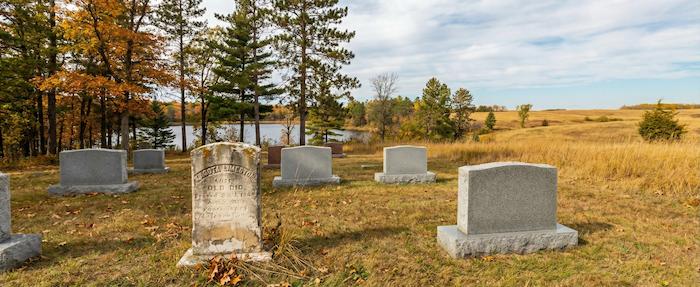
A headstone base set near one of these old kettle-margin zones can shift unevenly compared to a marker on more stable ground just a short distance away, without any single dramatic event to point to. The movement tends to happen in small increments over years, easy to overlook until enough of them add up, and by the time a corner visibly drops below grade or a stone leans noticeably out of plumb, the settling underneath has usually been underway far longer than the visible tilt suggests. Families searching for headstone cleaning services near me around Minnetonka often begin that search only after noticing a stone dropped or tilted along what turns out to be old kettle terrain, assuming a simple cleaning might explain away a shift that is actually structural. Tending checks the surrounding ground history before resetting an affected base, since kettle-margin settling calls for a different footing approach than ordinary till, typically a wider and deeper footing that spreads the monument's weight across more of the looser fill, something a standard base sitting on firmer ground never has to account for. Larger structural repairs are covered under headstone repair and restoration.

Proximity to a Major Lake Deepens Shade and Algae
A lake as large as Minnetonka, with more than a hundred miles of shoreline, keeps the air noticeably more humid in the immediate surrounding area than it is even a short distance inland, and older cemetery plots near the water hold onto that extra moisture for days after a storm passes. Combined with the mature tree cover common around the lake's older, established neighborhoods, that humidity gives algae a persistent foothold on shaded stone that drier, inland plots don't deal with nearly as much. A marker set in an open, sunny section a mile from the lake often stays cleaner for decades longer than a comparable stone tucked into shade right along the shoreline, and the difference tends to show up first in the low, north-facing corners of a monument, where sun rarely reaches even on clear days.

Bronze veterans' plaques in the same lakeside plots develop a heavier green corrosion for the same reason, since the moisture accelerates the metal's natural patina well beyond what a drier, sunnier plot would produce over the same span of years. During that same visit, Tending addresses the bronze separately from the stone, treating the plaque's surface to lift the accelerated buildup and bring the finish back to a stable, protected state under the bronze marker cleaning and restoration service, while a soft-wash biocide treatment handles the algae on the stone itself without disturbing the surface underneath.
Lake-Moderated Temperatures Multiply Freeze-Thaw Cycles
Large bodies of water buffer nearby air temperature, keeping it hovering closer to freezing for longer stretches than it would inland, and that buffering effect means ground right along Minnetonka's shoreline crosses the freezing point more times each winter than ground a few miles away that swings decisively into deep cold and stays there. Each of those extra transitions works into the same hairline cracks along a stone's natural grain, and engraved lettering on older markers near the water tends to wear shallow faster than lettering on comparable stones set further inland, even when both stones came from the same quarry originally. The mechanism is simple but relentless: water seeps into a crack, expands by roughly nine percent as it freezes, and widens the crack fractionally before melting again, and a shoreline plot can cycle through that sequence dozens of extra times in a single winter compared to a plot further from the moderating effect of the open water.
Under headstone lettering repair standards adjusted for that added cycling, Tending re-engraves and reseals lettering that has gone shallow from this lakeside freeze-thaw pattern, restoring legibility to inscriptions that have worn thin over the decades of extra exposure.
Service Costs in Minnetonka
Entering the monument type and the desired care plan into Tending's online calculator produces a fixed price right away, without waiting on a technician to visit the cemetery and inspect the damage in person first. Because kettle terrain, lakeside shade, and the extra freeze-thaw cycling near open water are ongoing conditions that return every year and don't resolve permanently on their own, an optional maintenance plan can be added to the same order for markers exposed to any of the three.
- Base resetting and stabilization: correcting settlement over old kettle-margin ground.
- Algae removal and bronze cleaning: soft-wash treatment for lakeside humidity and shade.
- lettering repair: recutting engraving worn by lake-moderated freeze-thaw cycling.