
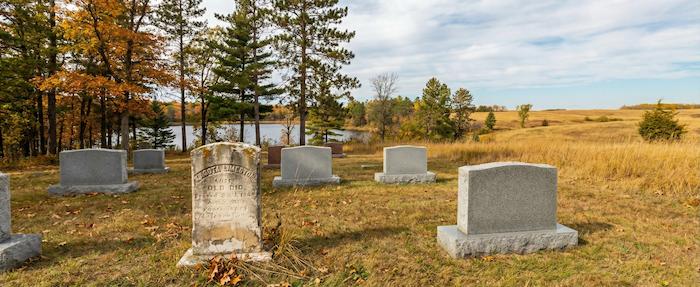
Weathered St. Peter Sandstone Settles Shallow Foundations
The bedrock under much of the Twin Cities metro, Apple Valley included, follows a distinctive three-layer stack: St. Peter Sandstone at the bottom, a thin cap of Glenwood Shale above it, and Platteville Limestone on top. St. Peter Sandstone has a reputation among local builders and cave explorers alike for being unusually soft and poorly cemented, crumbling almost to loose sand where water has worked through it for long enough. The rock's rounded quartz grains were never tightly bound to begin with, held together mostly by a thin film of silica and iron oxide that dissolves readily once acidic groundwater starts moving through it, which is why the stone can lose measurable strength within a single human lifetime, not over the geologic timescales sandstone usually needs. Where that weathered sandstone sits close enough to the surface, a headstone foundation resting on it doesn't have the same solid support that granite or dense till would provide.

A base set into ground with shallow, weakened sandstone underneath can settle gradually as the rock itself slowly breaks down and compacts, a different mechanism than clay shrink-swell or straightforward frost heave. Where frost heave tends to push a stone upward and clay shrink-swell rocks it side to side, sandstone breakdown usually pulls a foundation straight down and slightly out of plumb, often the first visible clue a technician looks for before any digging starts. That distinction matters for how the problem gets fixed, since the usual footing depth calculated for clay or till doesn't account for rock that's still actively deteriorating below it. Families searching for headstone cleaning services near me in Apple Valley often reach out after noticing a stone that has dropped noticeably with no visible cracking to explain it. Tending checks bedrock depth and condition before resetting an affected base, since a standard footing over still-weathering sandstone won't hold for long. Larger structural repairs are covered under headstone repair and restoration.

Calcareous Glacial Till Deposits Lime Crust on Stone
The Des Moines lobe glacier that shaped this part of Minnesota left behind a distinctly calcareous till, gray to brown clay loaded with lime picked up as the ice ground through carbonate rock further north. Groundwater moving through that lime-rich till carries dissolved calcium up into a headstone's base, and as the water evaporates it leaves a pale, chalky crust behind — mineral buildup, not dirt, and one that resists a plain-water rinse the way ordinary grime doesn't. The process works much like efflorescence on a basement wall: capillary action wicks the mineral-laden water up through the stone's pores, and once it reaches open air the dissolved calcium comes out of solution and hardens into a crust, which is why buildup tends to concentrate low on a monument near ground level and fade out higher up the stone.
"This is my first experience, and they have entrusted me with their loyalty. No question goes unanswered, and their delivery and performance are excellent."
— GaryD, Tending Client
Bronze veterans' plaques set into the same calcareous till can develop a similar light film where the same mineral-rich groundwater reaches the metal. Tending treats the lime crust with a calcium-targeted chelating solution, and on plots where a nearby bronze plaque shows the same mineral haze, that same visit extends to bronze grave marker restoration, cleaning and resealing the metal against the till chemistry causing it. Most stones only need this specific treatment repeated every few years, not at every routine cleaning.
Dakota County's Lake-Dotted Terrain Deepens Shade and Algae
Apple Valley and the surrounding Dakota County landscape carry the small lakes, wetlands, and low, poorly drained pockets typical of glacial terrain, and older cemetery sections tucked near this kind of ground stay damp for days longer after a storm than plots on higher, better-drained soil nearby. That extra moisture, paired with mature tree cover in many of the area's older plots, gives algae a head start it wouldn't get on drier ground. Mature oak and cottonwood canopy common to these older sections blocks enough direct sun that a north-facing stone face can stay damp through most of a summer week, and airborne algae spores settle fastest on exactly that kind of consistently shaded, moisture-holding surface. Two markers set the same year can end up looking decades apart in condition depending on which one landed in the damper section of the cemetery. Engraved lettering under a heavy growth becomes hard to read well before the carving itself shows real wear.
Tending clears algae with a soft-wash biocide suited to Dakota County's damp, low-lying plots, then recuts and repaints any lettering that's gone shallow underneath, following headstone lettering repair standards adjusted for consistently moist ground.
Service Costs in Apple Valley
Selecting the monument type and care plan inside Tending's online calculator returns a fixed quote without needing a technician on-site to inspect the damage beforehand. Because shallow bedrock, mineral buildup, and persistent shade all develop gradually and tend to resurface season after season, a maintenance plan covering any of the three can be added at checkout.
- Base resetting and stabilization: correcting settlement over weathered sandstone bedrock.
- Lime crust removal and bronze cleaning: chelating treatment for calcareous till deposits.
- Algae removal with lettering repair: biocide cleaning and recutting for shaded, damp plots.