
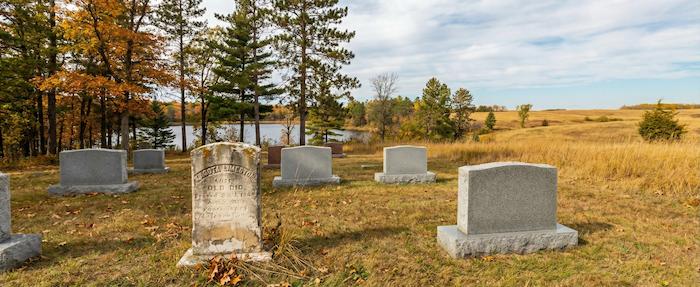
Stone Care in the Deep Freeze
Minneapolis winters are hard on masonry. The ground freezes four feet down. The temperature swings snap stone and heave foundations. In places like Lakewood and Pioneers and Soldiers, we fight the elements constantly.
We deal with local St. Cloud granite that rusts from the inside, and limestone markers that dissolve under the spray of road salt. The city also irrigates heavily in summer, leaving hard water deposits that turn polished monuments white. Families searching for headstone cleaning services near me call us to remove these mineral stains and reset markers that the frost has thrown out of level.
The 42-Inch Frost Line
The frost line in Minneapolis is deeper than almost anywhere else we work. It goes down 42 inches. That is a massive amount of soil moving every winter.
We see massive monuments lifted and tilted. Shallow foundations crack. To fix this, we dig deep—past that 42-inch mark. We replace the clay soil with crushed rock. Rock doesn't hold water. If there is no water to freeze, the ground stays solid, and the monument stays straight.
Road Salt Spalling
Minneapolis uses tons of salt on the roads. Plows spray this salty slush onto the roadside cemeteries like St. Mary’s.
The salt water soaks into the stone pores. When it dries, salt crystals grow inside the rock. They push the face of the stone off. We call this spalling. We use a desalination poultice to draw the salt out before it shatters the inscription.
Irrigation Scale (Hard Water)
Sprinklers run constantly in the summer to save the grass. But the local water is loaded with minerals.
Sprinklers hit the stones every day. The water evaporates, leaving a hard white haze or orange rust streaks. This "scale" bonds to the polish. You can't scrub it off. We use a specialized acidic cleaner that dissolves the minerals without burning the granite surface.
St. Cloud Granite Rust
Much of the local stone is St. Cloud Granite. It is famous for its strength, but it contains iron deposits.
Over time, moisture gets to that iron. It rusts. We see dark grey stones develop bright orange bleed spots. This is internal rust. We apply a chemical reducing agent. It converts the rust back into a soluble form. We rinse it out, and the grey color returns.
Limestone Dissolution
Historic markers in Pioneers and Soldiers Cemetery are often limestone. Limestone is soft. Acid rain and road exhaust eat it away.
The lettering softens and blurs. The stone surface feels like sandpaper. We clean these stones gently to remove biological growth that holds acid. Then we apply a consolidant. It soaks in and strengthens the stone matrix to slow down the weathering.
Biological Growth under Snow
Snow covers the stones for months. It insulates the ground. Under that snow, mold and lichen stay damp and active.
When the snow melts, we find monuments covered in black and green slime. This growth eats into the polish. We treat it with a biocide that kills the roots. The dead growth dries up and washes off with the spring rains.
Sinking Flat Markers
The freeze-thaw cycle churns the soil. Flat markers sink as the ground thaws and turns to mud in April.
The grass grows over them. We locate them, cut the sod back, and lift the stone. We pack the hole with angular gravel. This creates a drainage layer. The gravel locks together and keeps the marker flush with the ground, even when the soil turns soft.
Service Costs in Minneapolis
Digging below the deep frost line takes heavy equipment. removing hard water scale from polished granite is delicate chemical work. We inspect the monument to determine the extent of the damage before providing a quote.
- Deep Leveling: Resetting foundations below the 42" frost line.
- Scale Removal: Cleaning calcium/iron deposits from irrigation.
- Salt Extraction: Removing road salt to stop spalling.
- Rust Treatment: Removing iron stains from St. Cloud granite.


